
You’ve Found the House — But the Down Payment Is Short
You’ve spent months touring open houses, tracking mortgage rates, and finally — finally — you’ve found the one. Three bedrooms, a fenced backyard, a kitchen that doesn’t smell like the previous owner’s curry experiments. You’re ready to make an offer.
Then you check your savings account.
You’ve got enough for closing costs and maybe a 5% down payment, but the home you really want — and the one that lets you avoid private mortgage insurance (PMI) — needs 20% down. That gap could be $30,000, $50,000, or more. Meanwhile, your 401(k) balance is sitting there, quietly accumulating, looking like an awfully tempting piggy bank.
So here’s the central question every first-time homebuyer in this position eventually asks: Is borrowing from your 401(k) a smart way to cover your first down payment?
The honest answer is — it depends. A 401(k) loan can be a fast, low-friction source of cash, but it comes with real risks to your retirement, your job security, and even your mortgage approval. In this guide, we’ll walk through exactly how it works, when it might make sense, the downsides you absolutely need to understand, and the safer down payment options you should consider first.
What Is a 401(k) Loan?
A 401(k) loan is exactly what it sounds like: you borrow money from your own employer-sponsored retirement plan and pay it back to yourself over time, with interest. It is not the same as a 401k withdrawal vs loan — that distinction matters enormously.
Here’s how the three main ways to access 401(k) funds differ:
| Access Method | What Happens | Tax Consequence | Penalty |
|---|---|---|---|
| 401(k) Loan | You borrow and repay with interest | None if repaid on time | None if repaid on time |
| Hardship Withdrawal | You take money out permanently for an “immediate and heavy financial need” | Ordinary income tax on the amount | 10% early withdrawal penalty if under 59½ |
| Regular Withdrawal | You cash out part of your balance | Ordinary income tax | 10% penalty if under 59½ |
With a loan, repayment typically happens through automatic payroll deductions — the money comes out of your paycheck before you even see it. And the interest you pay (usually prime rate plus one or two percentage points) goes right back into your own 401(k) account. It can feel like you’re borrowing from yourself for free.
But “free” is a misleading word here, as we’ll see.
IRS 401(k) Loan Limits
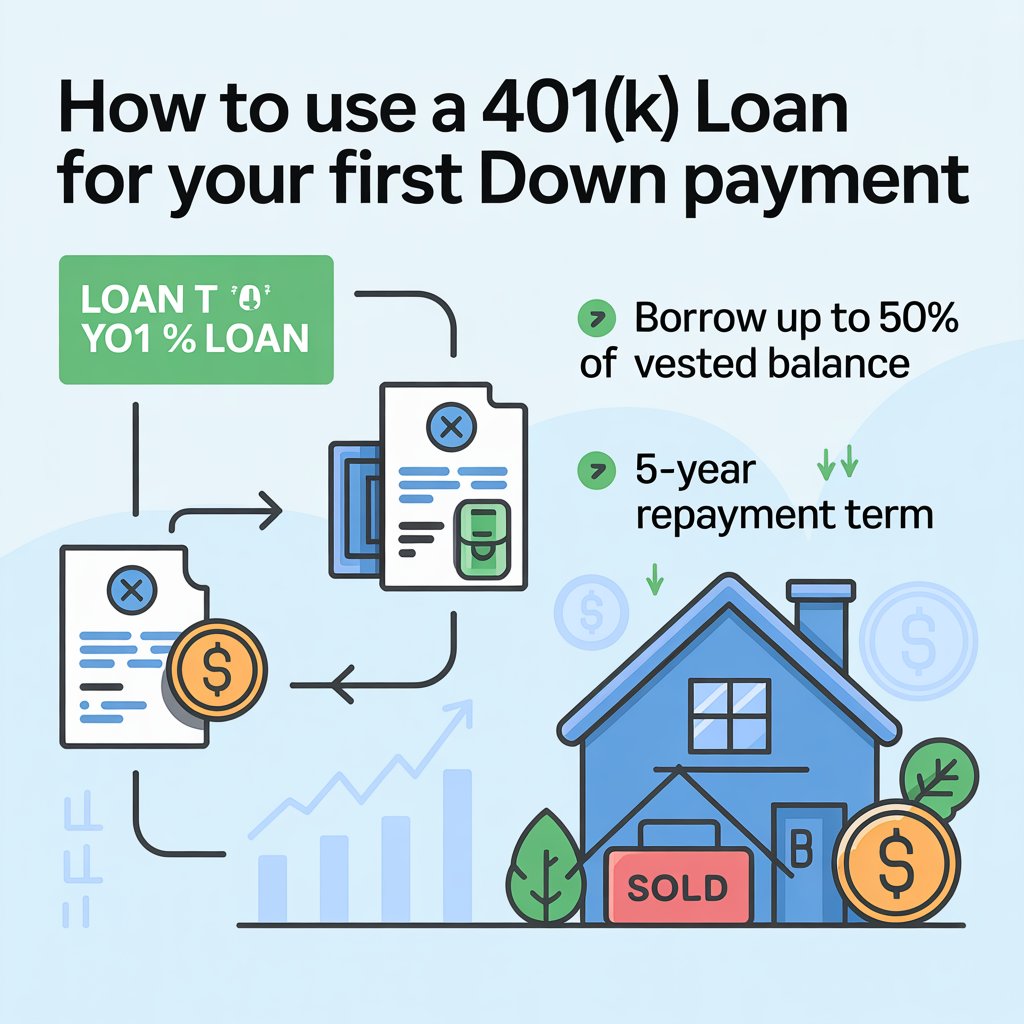
Under IRS 401(k) loan limits, the maximum you can borrow is the lesser of:
- $50,000, or
- 50% of your vested account balance
There is a special floor: if 50% of your vested balance is less than $10,000, some plans allow you to borrow up to $10,000 anyway. And if your vested balance is below $10,000, you may be limited to borrowing only what you have.
Your specific employer plan may impose stricter limits than the IRS allows, so always check your plan documents.
Eligibility, Limits, and the Loan Process
Not every employer offers 401(k) loans. Your plan’s Summary Plan Description (SPD) will tell you whether loans are permitted and what the specific rules are.
Step-by-Step: How to Borrow from Your 401(k)
- Review your plan documents. Confirm loans are allowed, check the maximum loan amount, and see if your plan permits extended repayment terms for a primary residence.
- Request the loan. Most plans let you do this online through your 401(k) provider’s portal (Fidelity, Vanguard, Empower, etc.) or by contacting your HR/benefits department.
- Provide documentation. For a home purchase, you may need to supply a purchase agreement or other proof that the funds are for a primary residence. Some plans require this to qualify for a longer repayment term.
- Wait for approval and disbursement. Approval can take anywhere from a few days to a couple of weeks. Funds are typically delivered via check or direct deposit.
- Begin repayment. Payroll deductions start automatically, usually on your next pay cycle.
Repayment Terms
- General-purpose loans: Typically must be repaid within 5 years.
- Primary residence loans: Some plans allow extended terms of 10, 15, or even 30 years — but not all plans offer this. This is a critical detail to verify, because a 5-year repayment on a $50,000 loan means roughly $833 per month leaving your paycheck, which will affect your debt-to-income ratio.
You must also make at least quarterly payments to stay compliant with IRS rules, though most plans structure payments with every paycheck.
Pros: Why Some Buyers Consider a 401(k) Loan
Borrowing from your 401(k) isn’t irrational. There are legitimate reasons first-time homebuyers reach for this option:
- No credit check. The loan is secured by your own retirement balance, so your credit score doesn’t matter. If you’ve got a thin credit file or a recent blemish, this can be a path forward when other lenders say no.
- Interest paid back to yourself. The interest you pay doesn’t go to a bank — it goes back into your retirement account. This is a genuine advantage over a personal loan or credit card.
- Lower interest than many alternatives. Rates typically hover around prime + 1% or 2%, which at current rates is often cheaper than a personal loan, HELOC, or credit card.
- Speed and convenience. No underwriting, no appraisal, no third-party approval. If your plan allows online requests, you can have funds in hand within days.
- Avoiding PMI. If a 401(k) loan is what pushes you from a 10% down payment to 20%, you could save hundreds of dollars per month in private mortgage insurance — potentially thousands over the life of the loan.
- Bridging a timing gap. Some buyers use a 401(k) loan to cover earnest money or closing costs when their liquid savings are temporarily tied up.
Cons and Risks: The Part You Cannot Skip
Now for the reality check. A retirement account loan carries risks that many first-time homebuyers underestimate. Let’s go through them one by one.
1. Opportunity Cost: The Math That Hurts
When you pull $30,000 out of your 401(k), that money stops growing in the market. Even if you pay it all back with interest, you’ve lost the compound growth that money would have earned.
Illustrative example: You borrow $30,000 from your 401(k) today and repay it over 5 years at 6% interest. You pay back roughly $35,300 total. But if that $30,000 had stayed invested and earned an average 8% annual return over 10 years, it would have grown to about $64,768. The difference — nearly $30,000 in lost growth — is the real cost of the loan, and it’s a cost that compounds over your entire career.
This is what financial planners mean by opportunity cost retirement impact. The younger you are, the more it stings.
2. Job Loss or Departure: The 60-to-90-Day Trap
This is the single biggest risk. If you leave your job — whether you’re laid off, fired, or you quit — your outstanding 401(k) loan balance typically becomes due within 60 to 90 days. If you can’t repay it:
- The unpaid balance is treated as a taxable distribution.
- You owe ordinary income tax on the full amount.
- If you’re under age 59½, you also owe a 10% early withdrawal penalty.
On a $40,000 outstanding balance, that could mean $10,000+ in federal taxes and $4,000 in penalties — essentially a five-figure surprise during what is already a financially stressful time.
The SECURE 2.0 Act did extend the repayment deadline to the tax filing deadline (including extensions) of the year following the year you leave your job, which is an improvement over the old 60-day rule. But the underlying risk remains.
3. The “Double Taxation” Myth — Clarified
You may have heard that 401(k) loan interest is “double-taxed.” Here’s the nuance: you repay the loan with after-tax dollars, and when you eventually withdraw the money in retirement, it’s taxed again as ordinary income. Technically, this is double taxation on the interest portion — but the interest rate is relatively low, so the actual dollar impact is modest. The far bigger tax risk is the job-loss scenario above.
4. Impact on Retirement Readiness
Even if you repay every dollar, you’ve interrupted years of tax-advantaged compounding. Studies from Vanguard and Fidelity consistently show that 401(k) borrowers tend to reduce or pause their regular contributions while repaying the loan, compounding the damage. Many also borrow again.
5. Administrative Fees and Employer Match Pauses
Some plans charge a loan origination fee ($50–$100) and annual maintenance fees. More importantly, some employers pause matching contributions while you have an outstanding loan. If your employer matches 50% of your contributions up to 6% of salary, pausing those contributions while you repay the loan could cost you thousands in free money.
6. Potential Effect on Mortgage Approval
Can a 401(k) loan hurt your chances of getting the mortgage itself? Potentially, yes. If your repayment term is short (5 years), the monthly payment may be counted in your debt-to-income (DTI) ratio by the mortgage underwriter. We cover this in depth below.
How a 401(k) Loan Affects Your Mortgage Application
Mortgage underwriters scrutinize the source of your down payment. They want to verify that the funds are “seasoned” (have been in your account for at least 60 days) or that the source is documented and acceptable.
Here’s what you need to know about mortgage underwriting 401k loan treatment:
- FHA loans: FHA guidelines generally allow 401(k) loan proceeds as a down payment source, and the 401(k) loan payment may be included in your DTI if the loan has a remaining term of 12 months or more.
- Conventional loans (Fannie Mae / Freddie Mac): These also permit 401(k) loans as a funding source. If the repayment term extends beyond 12 months from the mortgage closing date, the monthly payment is typically counted in your DTI.
- VA and USDA loans: Similar treatment — 401(k) loan payments with more than 12 months remaining are generally included in DTI.
What This Means Practically
A $40,000 loan repaid over 5 years means roughly $773/month in your DTI calculation. If your gross monthly income is $7,000, that single loan payment eats up 11% of your DTI — which could push you above the typical 43–50% DTI ceiling and jeopardize your mortgage approval.
Pro tip: If your plan allows a longer repayment term for primary residence loans (say, 15 or 30 years), the monthly payment drops dramatically and the DTI impact is minimal. Ask your plan administrator about this before you apply for the mortgage.
Disclose early. Tell your mortgage lender about the 401(k) loan during pre-approval, not at closing. A surprise line item on your bank statements can delay or derail the process.
When It Might Actually Make Sense
A 401(k) loan for a down payment isn’t universally a bad idea. It may be the right call if you can check most of these boxes:
The Decision Checklist
- ✅ You have stable employment and no realistic expectation of job loss or career change in the next 3–5 years.
- ✅ You have a fully funded emergency fund and retirement contributions won’t be paused while you repay.
- ✅ Your plan allows a long repayment term (15+ years) for primary residence loans, keeping monthly payments low.
- ✅ The loan will help you avoid PMI, saving you $150–$400/month, and the total savings exceed the opportunity cost.
- ✅ You’ve exhausted lower-risk alternatives (gifts, down payment assistance, low-down-payment programs).
- ✅ You can repay aggressively — making extra payments to reduce the compounding gap.
- ✅ Your mortgage lender has confirmed the loan payment won’t push your DTI over the limit.
If you’re checking six or seven of those boxes, a 401(k) loan moves from “risky gamble” to “calculated tool.”
Safer Alternatives to Explore First
Before you tap your retirement, consider these down payment options that carry less long-term risk:
Low Down Payment Mortgage Programs
- FHA loan down payment: Only 3.5% down required with a credit score of 580+. Ideal for first-time buyers.
- Conventional 97 / HomeReady / Home Possible: As little as 3% down with income-eligible programs. These are often cheaper than FHA over the long term because mortgage insurance can be canceled.
- VA loans: $0 down for eligible veterans and service members.
- USDA loans: $0 down for homes in eligible rural and suburban areas.
Roth IRA First-Time Homebuyer Exception
If you have a Roth IRA, you can withdraw your contributions (not earnings) at any time, tax-free and penalty-free. Additionally, the IRS allows a $10,000 lifetime exception for first-time homebuyers to withdraw earnings without the 10% penalty (though earnings are still taxable in a Traditional IRA). With a Roth, qualified earnings withdrawals may also be tax-free if the account is over 5 years old. This is often a better source than a 401(k) because there’s no repayment obligation and no job-loss risk.
Down Payment Assistance Programs (DPA)
State and local down payment assistance programs offer grants, forgivable loans, or low-interest second mortgages to first-time homebuyers. HUD maintains a state-by-state directory at hud.gov. Many buyers qualify for $5,000–$25,000 in assistance they didn’t know existed.
Gift Funds
Most conventional, FHA, and VA loans allow gift funds from family members to cover part or all of your down payment. A simple gift letter is usually all that’s required.
HELOC vs 401k Loan
If you already own a property (or a family member does), a home equity line of credit (HELOC) can provide funds at competitive rates. The downside: it’s secured by real estate, so default means foreclosure risk. A personal loan is unsecured but typically carries higher interest.
Two Real-World Scenarios
Scenario A: The Loan That Worked
Marcus, 32, software engineer. $85,000 in his 401(k), stable job at a Fortune 500 company for 6 years. Wanted to put 20% down on a $350,000 home to avoid PMI ($280/month savings). Borrowed $30,000 with a 15-year repayment term. Monthly payment: ~$252. His employer continued matching. He paid it off in 4 years with extra payments. Total opportunity cost: ~$12,000 in lost growth over 10 years. Total PMI savings over 4 years: ~$13,440. Net result: roughly break-even, with the psychological benefit of owning a home sooner.
Scenario B: The Loan That Backfired
Priya, 28, marketing manager. $42,000 in her 401(k). Borrowed $21,000 with a 5-year term. Eight months later, her company downsized and she was laid off. She had 90 days to repay the $19,200 outstanding balance. She couldn’t. The balance was treated as a distribution: $4,600 in federal/state taxes and a $1,920 early withdrawal penalty — $6,520 out of pocket on top of losing her job. She also had to pause 401(k) contributions at her new job while rebuilding her emergency fund.
How to Minimize Harm If You Proceed
If you’ve weighed the alternatives and decided a 401(k) loan is still the right move, take these steps to protect yourself:
- Keep a cash emergency fund of at least 3–6 months of expenses — separate from your down payment funds. This is your safety net if you lose your job.
- Repay aggressively. Every extra dollar you pay reduces the compounding gap.
- Don’t pause your regular contributions. If your budget allows, keep contributing at least enough to get your full employer match.
- Get the longest repayment term your plan allows for primary residence loans.
- Confirm DTI treatment with your mortgage lender before closing.
- Set a personal payoff deadline shorter than the plan term — aim for 3–5 years even if your plan allows 15.
Your Actionable Pre-Borrowing Checklist
Before you click “request loan” in your 401(k) portal, make sure you’ve done the following:
- [ ] Read your plan’s Summary Plan Description and confirmed loan terms, fees, and repayment options.
- [ ] Spoken with your plan administrator about primary-residence repayment extensions.
- [ ] Talked to your mortgage lender about how the loan will affect your DTI and pre-approval.
- [ ] Run a retirement impact scenario (use a compound interest calculator to project the lost growth over 10, 20, and 30 years).
- [ ] Researched at least two down payment assistance programs in your state.
- [ ] Consulted a certified financial planner or tax professional.
- [ ] Verified your emergency fund is intact and will remain intact after the down payment.
The Bottom Line
A 401(k) loan can be a practical tool for covering a mortgage down payment — but it’s a tool with sharp edges. The interest you pay yourself is real, but so is the compounding you lose. The convenience is real, but so is the catastrophic risk if you lose your job. The monthly savings from avoiding PMI are real, but so is the possibility that the loan payment sabotages your mortgage approval.
For most first-time homebuyers, lower-risk alternatives — FHA loans, conventional 3% down programs, down payment assistance, Roth IRA contributions, and gift funds — should be exhausted before turning to a 401(k) loan. And if you do proceed, do it with your eyes open: a long repayment term, a solid emergency fund, stable employment, and a clear plan to repay early.
Your future retired self will thank you — or wonder what happened.
Ready to make a smart decision? Talk to your plan administrator and mortgage lender, run a retirement impact scenario, or schedule a quick call with a certified financial planner before you borrow.
Sources referenced: IRS Publication 575 and IRS.gov 401(k) loan guidance, Consumer Financial Protection Bureau (CFPB) mortgage resources, HUD.gov down payment assistance directory, Fannie Mae Selling Guide (B3-3.1-07), SECURE 2.0 Act of 2022 provisions.