
Why Asking the Right Mortgage Broker Questions Matters
Buying a home is one of the largest financial transactions of your life, and choosing the right financing is just as critical as finding the perfect house. While a real estate agent helps you find the property, a mortgage broker acts as your intermediary, shopping around with multiple lenders to find the best loan terms. Many buyers assume their real estate agent will handle the financing side, but agents rely on the brokers you choose. Understanding the difference between a lender vs broker, and knowing what to ask your mortgage broker before signing, is essential to protecting your bottom line.
Whether you are a first-time homebuyer seeking mortgage pre-approval or a repeat buyer looking to refinance, vetting your broker ensures you get transparent pricing and expert guidance. Asking the right mortgage broker questions helps you uncover hidden fees, understand your true borrowing costs, and avoid unnecessary delays. Taking control of this relationship means asking direct, pointed questions to ensure your financial future is secure. Let’s explore the essential questions to ask before signing a mortgage.
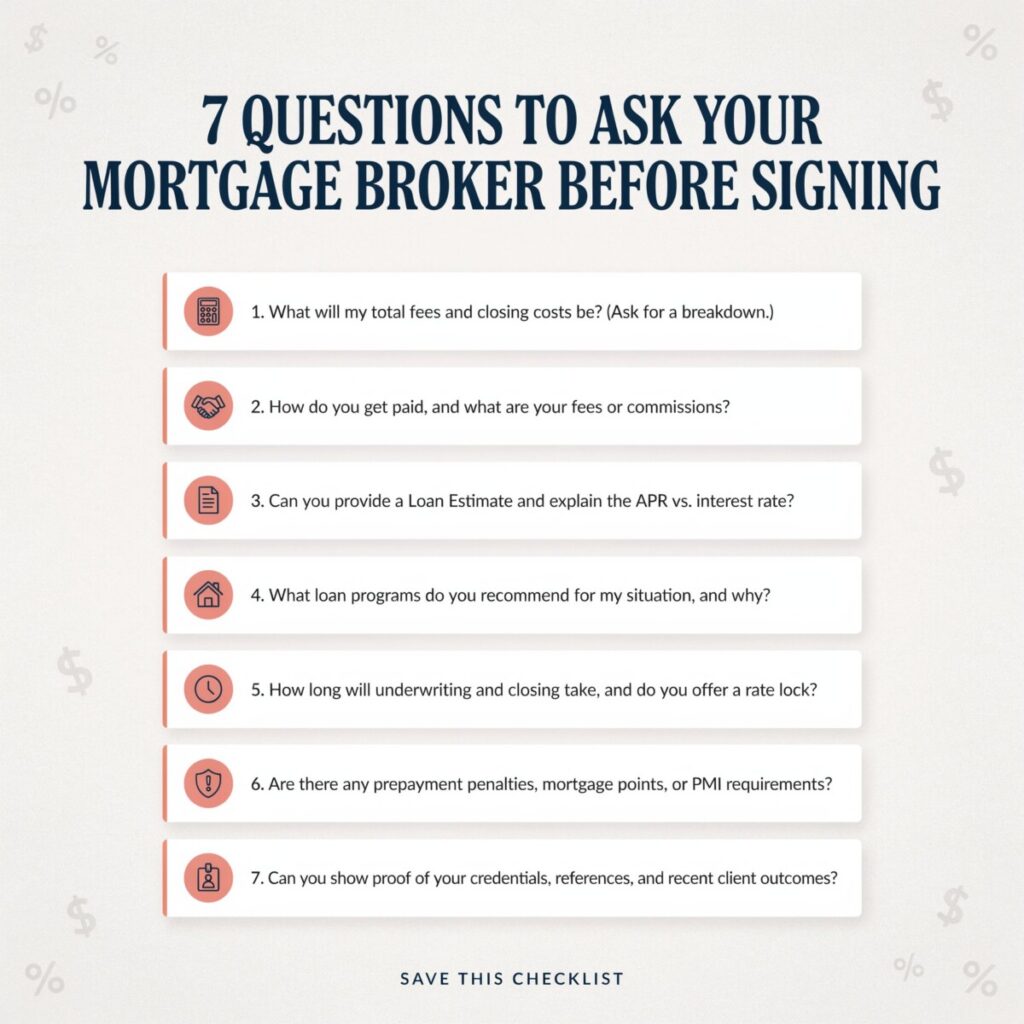
Quick checklist: 7 questions to bring to your mortgage appointment
- What will my total fees and closing costs be? (Ask for a breakdown.)
- How do you get paid, and what are your fees/commissions?
- Can you provide a Loan Estimate and explain the APR vs. interest rate?
- What loan programs do you recommend for my situation, and why?
- How long will underwriting and closing take, and do you offer a rate lock?
- Are there any prepayment penalties, mortgage points, or private mortgage insurance (PMI) requirements?
- Can you show proof of your credentials, references, and recent client outcomes?
1. What will my total fees and closing costs be? (Ask for a breakdown.)
Why it matters
When securing a home loan, the interest rate is only one piece of the puzzle. Mortgage closing costs can add up quickly, typically ranging from 2% to 5% of the loan amount. Getting a clear picture of these expenses early on prevents unpleasant surprises at the closing table. Understanding exactly what you are paying for helps you budget accurately and compare offers from different brokers fairly.
What a good answer sounds like
A trustworthy broker will gladly provide a detailed, itemized list of estimated mortgage closing costs. They should break down third-party fees (like appraisal, title insurance, and credit report fees) alongside lender fees and mortgage broker fees. They will also explain which costs are fixed and which might fluctuate before closing.
Red flags
Be wary if a broker gives you a vague lump-sum number, refuses to provide a written estimate upfront, or insists that “fees are just standard and non-negotiable.” Evasive answers about third-party vendor costs are a major warning sign.
Example
Imagine you are borrowing $300,000. A broker estimates your closing costs at $9,000. A good breakdown shows $3,000 for lender origination fees, $1,500 for title insurance, $600 for an appraisal, and the rest in prepaid taxes and insurance. If they just say “about $9,000,” you have no way to verify if you are being overcharged.
2. How do you get paid, and what are your fees/commissions?
Why it matters
Mortgage brokers are compensated for their services, but the way they earn their money can influence the loan products they recommend. Some earn commissions from the lender (yield spread premium), while others charge the borrower directly. Knowing how your broker gets paid ensures their interests align with yours and helps you fully understand mortgage broker fees explained in your specific transaction.
What a good answer sounds like
An honest broker will transparently explain their compensation structure. They should clarify whether they are paid by the lender, the borrower, or a combination of both. They will also confirm that they do not receive higher commissions for pushing specific, more expensive loan products or adjustable-rate mortgages over fixed-rate mortgages. Under federal law, a broker cannot be paid by both the borrower and the lender on the same transaction, nor can their compensation be based on the loan’s terms. Knowing your rights protects you from illegal steering.
Red flags
If a broker claims they work for “free” without explaining how they are compensated, or if they get defensive when asked about yield spread premiums, proceed with caution. You want a partner who is open about their income.
Example
Suppose a broker charges a 1% origination fee paid directly by you at closing. Alternatively, they might offer a “no-fee” loan where the lender pays them a commission, but your interest rate is bumped up by 0.25%. A good broker will present both scenarios so you can choose the most cost-effective route.
3. Can you provide a Loan Estimate and explain the APR vs. interest rate?
Why it matters
The Loan Estimate is a standardized, three-page form that lenders and brokers must provide within three business days of your mortgage pre-approval application. It details the loan terms, projected payments, and closing costs. Furthermore, understanding the difference between the annual percentage rate (APR) vs interest rate is crucial. The interest rate determines your monthly principal and interest payment, while the APR reflects the total cost of borrowing, including mortgage broker fees and points.
What a good answer sounds like
A professional broker will promptly issue a Loan Estimate and walk you through it line by line. They will clearly explain that the APR is almost always higher than the base interest rate because it incorporates financing charges. They will also remind you that a final Closing Disclosure will arrive a few days before closing, allowing you to compare final numbers to your initial estimate. They will use the APR to help you compare their offer against competing lenders on an apples-to-apples basis.
Red flags
A red flag is any reluctance to provide a formal Loan Estimate before you sign binding agreements or pay hefty application fees. Also, beware if a broker focuses exclusively on the low base interest rate while glossing over a significantly higher APR.
Example
A broker offers a 30-year fixed-rate mortgage at a 6.5% interest rate. However, the Loan Estimate shows an APR of 6.85%. The broker should explain that this 0.35% difference represents the upfront origination fees and mortgage points you are paying to secure that 6.5% rate.
4. What loan programs do you recommend for my situation, and why?
Why it matters
There is no one-size-fits-all home loan. Depending on your down payment, credit score, and financial goals, different programs will serve you better. From conventional loans to FHA, VA, or USDA loans, knowing which products the broker specializes in—and why they fit your profile—is a key part of what to ask your mortgage broker before signing.
What a good answer sounds like
The best mortgage broker will assess your complete financial picture before making a recommendation. They should explain the pros and cons of a fixed-rate mortgage versus an adjustable-rate mortgage (ARM), and detail the specific benefits of government-backed loans if you qualify. Their recommendation should be tailored to your timeline and risk tolerance.
Red flags
If a broker immediately pushes a single, specific loan product without asking detailed questions about your finances, they may be prioritizing their own convenience or commission over your best interests. Avoid brokers who are unfamiliar with niche programs that might benefit you.
Example
You are a first-time homebuyer with a 5% down payment and a 720 credit score. The broker might suggest a conventional 97 loan to avoid the upfront mortgage insurance premium associated with FHA loans, saving you thousands at closing while still allowing a low down payment.
5. How long will underwriting and closing take, and do you offer a rate lock?
Why it matters
The underwriting timeline can make or break a real estate transaction, especially in a competitive housing market. Delays can lead to missed closing dates and lost earnest money. Additionally, mortgage rates fluctuate daily. Securing a rate lock protects you from market spikes while your loan is being processed.
What a good answer sounds like
A reliable broker will give you a realistic underwriting timeline based on their current volume and your financial complexity. They should explain their rate lock policy, including how long the lock lasts (e.g., 30, 45, or 60 days), whether there is a fee to lock, and what happens if closing is delayed beyond the lock period. Some brokers offer a “float down” option, which allows you to secure a rate but still benefit if market rates drop significantly before closing. Ask if this feature is available and what the specific parameters are to trigger it.
Red flags
Be cautious if a broker promises an unrealistically fast closing without reviewing your documents, or if they are vague about rate lock extension fees. If rates rise and your lock expires due to their internal delays, you should not be the one left paying the difference.
Example
You find your dream home and need to close in 30 days. The broker locks your rate for 45 days at no extra cost, providing a buffer for any appraisal delays. If the appraisal takes two weeks, your rate is still protected, giving you peace of mind.
6. Are there any prepayment penalties, mortgage points, or private mortgage insurance (PMI) requirements?
Why it matters
Hidden restrictions and insurance requirements can drastically alter the long-term affordability of your home. A prepayment penalty charges you a fee for paying off your loan early, which is detrimental if you plan to refinance or sell. Meanwhile, understanding mortgage points (prepaid interest) and private mortgage insurance (PMI) helps you calculate your true monthly obligations.
What a good answer sounds like
A transparent broker will clearly state if the loan includes a prepayment penalty (most conventional loans today do not, but some non-QM loans might). They will explain how buying mortgage points affects your rate, and outline exactly when PMI will be required and how you can eventually have it removed once you reach 20% equity.
Red flags
Watch out for brokers who gloss over the long-term cost of PMI or fail to mention that paying discount points might not be worth it if you plan to move in five years. Any hesitation to provide the exact terms of a prepayment clause is a major red flag.
Example
You put 10% down on a conventional loan, requiring PMI. The broker explains that your PMI costs $150 a month but will automatically drop off once you reach 22% equity, or you can request cancellation at 20%. They also confirm there are zero prepayment penalties if you decide to refinance later.
7. Can you show proof of your credentials, references, and recent client outcomes?
Why it matters
Anyone can claim to be a mortgage expert, but verifying mortgage broker credentials ensures you are working with a licensed, ethical professional. Checking their NMLS license and reading reviews from past clients gives you confidence in their ability to deliver on their promises. Learning how to compare mortgage brokers often comes down to their track record.
What a good answer sounds like
A reputable broker will proudly share their NMLS number, allowing you to verify their licensing and check for any past disciplinary actions on the Nationwide Multistate Licensing System registry. They will also provide references or direct you to verified online reviews that highlight their communication and success rates.
Red flags
If a broker cannot immediately provide their NMLS number, or if their state licensing shows multiple complaints or lapses, walk away. Similarly, a lack of recent, verifiable client testimonials should give you pause.
Example
Before signing an agreement, you look up the broker’s NMLS number on the Consumer Access website. You see they have been licensed in your state for ten years with no disciplinary actions. You also read three recent reviews praising their ability to close complex self-employed loans on time.
How to Compare Mortgage Brokers and Verify Credentials
Learning how to compare mortgage brokers goes beyond just looking at the lowest advertised interest rate. Start by gathering Loan Estimates from at least three different brokers. Compare the APR, origination fees, and third-party mortgage closing costs line by line. Next, verify their credentials using the NMLS Consumer Access portal, a free, official government resource where you can confirm their NMLS license and check their employment history.
Ask friends, family, or your real estate agent for recommendations, but always do your own independent research. A broker who comes highly recommended might be great, but their specific loan programs might not align with your unique credit profile. Finally, evaluate their responsiveness. A broker who takes days to return your initial emails will likely be difficult to reach during the stressful underwriting process. Look for a professional who communicates clearly, respects your time, and proactively answers questions to ask before signing a mortgage.
Next Steps: Finalizing Your Mortgage Decision
Securing a home loan doesn’t have to be stressful if you go into the process prepared. By asking these seven essential mortgage broker questions, you empower yourself to make informed financial decisions, avoid costly pitfalls, and find the best mortgage broker for your unique needs. Remember to bring our hypothetical printable checklist to your appointments, and don’t hesitate to interview multiple professionals before making a choice. For highly complex financial situations, always consider consulting with a licensed financial advisor or real estate attorney. Ready to start your homebuying journey with confidence? Download our free one-page PDF checklist today, and step into your next mortgage appointment fully prepared!
FAQ: Common Mortgage Broker Questions
What if my broker refuses to disclose fees?
If a broker refuses to provide a transparent breakdown of fees or hesitates to issue a Loan Estimate, you should walk away. Transparency is a legal requirement and a hallmark of a trustworthy professional.
How do I verify an NMLS number?
You can verify any broker’s NMLS license for free by visiting the NMLS Consumer Access website (nmlsconsumeraccess.org). Simply enter the broker’s name or unique ID number to view their licensing status and history.
Are mortgage broker fees negotiable?
Yes, many fees are negotiable. While third-party costs like county recording fees are fixed, broker origination fees and administrative charges can sometimes be reduced or waived, especially if you have competing Loan Estimates from other lenders.