
A family-friendly neighborhood where the kids can walk to class, the playground is around the corner, and school events never require a parking strategy—that’s the appeal. Buying a house near a school can shorten your daily routine and, when it’s time to sell, attract other family buyers who want the same convenience.
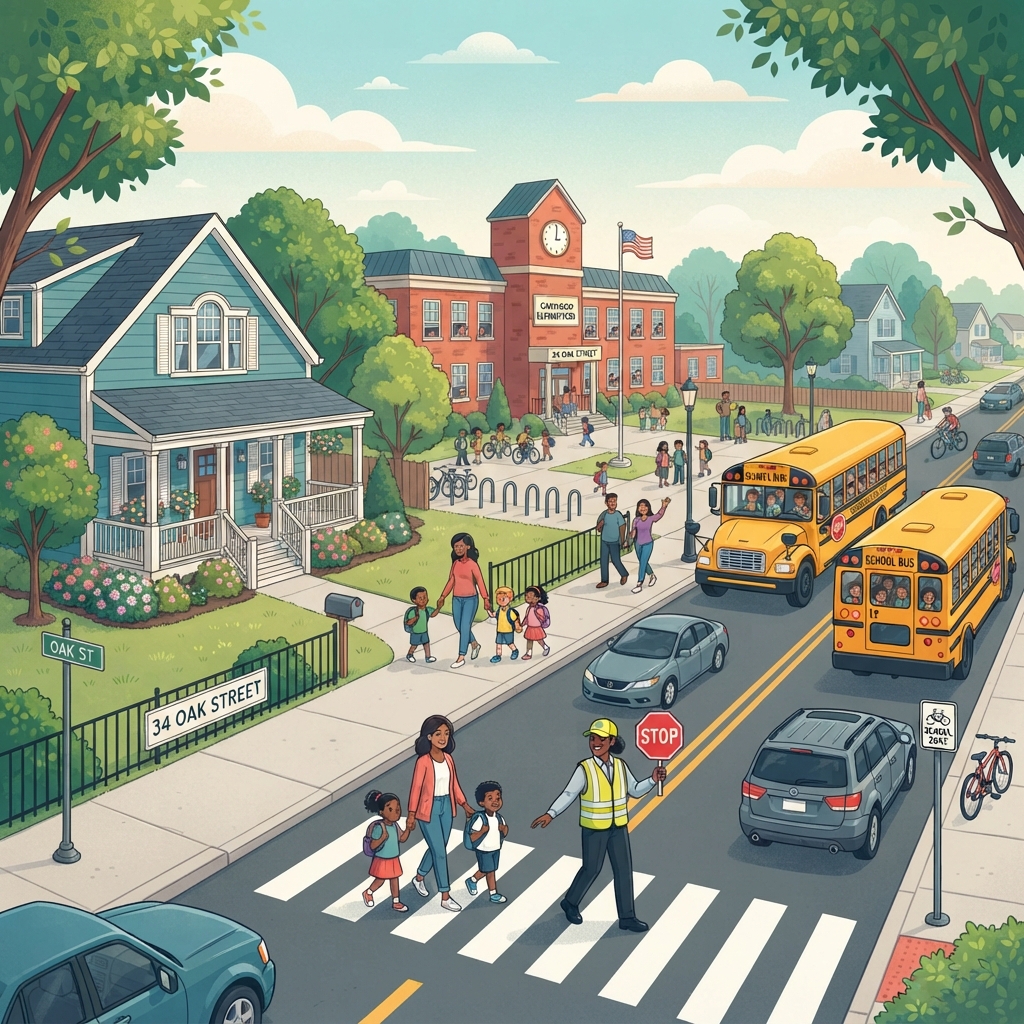
The tradeoff is real, though. High-traffic school zones bring morning and afternoon congestion, buses, visitor parking, recess and game-day noise, and lots of kids on foot and on bikes. A street that feels peaceful during a Saturday open house can look very different at 3 p.m. on a Tuesday. For commuters, the question is whether school traffic overlaps your route to work.
The right home near a busy school can still be an excellent choice. The trick is evaluating the street, not just the house. These tips for buying a home near a high-traffic school zone will help you weigh the convenience against the disruption—and make an offer with your eyes open.
Why Buyers Consider Homes Near Schools
Start with the upside, because it’s genuine:
- Convenient access to school and activities. Practices, concerts, and parent-teacher conferences are a short walk or a two-minute drive away.
- Less driving for households with school-age kids. Multiply two round trips a day by a full school year and the saved time adds up.
- Walkable extras. Schools often anchor parks, libraries, sports fields, and community events that the whole neighborhood enjoys.
- Potential appeal to future family buyers. When a school has a strong reputation, proximity can support resale demand—though it never guarantees a price.
Proximity Is Not the Same as School Assignment
Here’s the catch many first-time buyers miss: living near a school building doesn’t mean your kids will attend it. A home can sit across the street from a school and still be assigned to one miles away. Assignment follows school district boundaries, which can change as enrollment shifts. Confirm the assigned elementary, middle, and high schools with the district directly, ask whether boundary changes are under discussion, and compare property taxes and school funding across the areas you’re considering—tax bills can differ meaningfully from one district to the next.
Home Near School Zone Pros and Cons: The Main Tradeoffs
“High traffic” around a school is usually predictable, packed into short windows:
- School drop-off traffic before the first bell and school pickup congestion after dismissal, including long parent lines
- School buses, delivery vans, and staff parking competing for curb space
- Cars backing out of driveways and crossing sidewalks
- Tight visitor and street parking during concerts, games, and open houses
- Noise from recess, PA announcements, athletic practices, and weekend events
- More pedestrians and bikes—a plus for community life, but a reason for everyone to drive slowly
None of this makes a school a bad neighbor. It simply means the closest homes experience it most intensely. Homes directly adjacent to the school, facing a drop-off lane, or sitting on a main collector road absorb the most disruption. Homes a few blocks away often keep the convenience with far less noise.
| Factor | Directly adjacent to a school | A few blocks away |
|---|---|---|
| Drop-off and pickup traffic | At your doorstep twice daily | Usually light; watch for cut-through drivers |
| Street parking | Tight during school hours and events | Generally easier |
| Noise | Bells, PA systems, recess, and games carry | Mostly typical neighborhood sounds |
| Walk to school | Very short, often no major crossings | Still short; may cross a busier street |
| Resale buyer pool | Strong with proximity-focused families; some buyers pass | Broad appeal to families and other buyers |
As Realtor.com’s guidance on school-zone homes notes, proximity to a good school can boost value, while day-to-day traffic rules, noise, and event activity are the hidden costs of being right next door.
Visit at the Right Times
A weekend showing captures the neighborhood at its quietest. Before you get serious:
- Visit on a regular school day—ideally during both morning drop-off and afternoon dismissal.
- Drive your likely commute route at rush hour; school traffic can stack on top of commuter traffic.
- Walk the exact route a child would take to school or the bus stop.
- Return after dark to check street lighting, visibility, and driver behavior.
- Observe a sports game or weekend event if one is scheduled.
- If you can, visit in more than one season; dark winter afternoons and spring sports season feel different.
- Ask neighbors about noise, parking, speeding, and seasonal changes like band season or tournament weekends.
Buyer observation checklist
- Does the pickup line reach the home’s driveway or block the corner?
- Where do waiting parents park?
- Do drivers obey posted school zone speed limits?
- Are sidewalks and crosswalks continuous and unobstructed?
- Is there a crossing guard at the busiest intersection?
- Can you hear bells and announcements from the yard—and from bedrooms with the windows closed?
- Could you pull out of your own driveway at dismissal time?
What this looks like in practice
Say a family falls for a four-bedroom home two blocks from an elementary school. Before making an offer, they visit at 7:30 a.m. and 3:15 p.m. on a school day. The morning is calm because most families walk. At dismissal, the pickup line briefly slows the corner but clears quickly and never blocks the driveway. They also learn that Friday game crowds park two streets over. Their agent confirms the pattern with two neighbors, and the family moves forward with confidence.
Evaluate Pedestrian Safety and Walkability
Walkability and school access are the whole point of buying near a school—but a safe walking route to school is built from specific details. Check for:
- Continuous sidewalks, marked crosswalks, and curb ramps along the entire route
- Crossing guards, traffic signals, and safe intersections at the busiest corners
- Whether the route crosses a busy road, a blind curve, or an unmarked stretch
- Bus stops with adequate lighting and room to wait away from traffic
- Traffic calming: speed humps, reduced school zone speed limits, clear signage, and visible enforcement
If your kids will bike, look for bike lanes or low-speed side streets and a route that avoids the drop-off lane itself. Ask the school how arrival and dismissal work—where walkers enter, where buses queue, and which corners get busiest.
The National Highway Traffic Safety Administration urges drivers to slow down, yield at crosswalks, and follow speed limits in school zones and neighborhoods where children are present, and it tells walkers to use sidewalks and cross at crosswalks or intersections. Its walkability checklist is a handy tool to bring along on your route walk.
Walk the route with your kids
If you have children, walk it together at dismissal and watch how drivers actually behave. Do they stop fully at crosswalks, or roll through? Talk through where to cross, where to wait, and how to make eye contact with drivers. Pedestrian safety near schools depends on both infrastructure and habits—you can assess the first before you buy and build the second afterward.
How to Evaluate School-Zone Traffic and Future Changes
One visit is a snapshot, not the full picture. Dig deeper:
- Ask the listing agent, local police department, and city public-works or transportation office about known traffic concerns around the school.
- Ask whether the city has completed a traffic study for the neighborhood and whether the findings are public.
- Check zoning and future development: planned road projects, new housing, or a school expansion can change traffic volume on your street.
- Ask the school office about enrollment growth or planned changes to pickup and drop-off procedures.
- Watch whether your street serves as a cut-through route during commute hours.
- Confirm parking restrictions, one-way patterns, and event-day rules—some municipalities add special curbside rules near schools.
- Verify the home’s own parking: a driveway, garage, or deeded off-street space is worth a premium here.
A quick call to the city planning office can reveal permit applications that never make the listing description. Buy the future, not just the present: an empty lot near the school that’s zoned for expansion or new housing could reshape your street within a few years, so today’s quiet isn’t a guarantee.
Assess Noise, Privacy, and Outdoor Living
School zone traffic noise follows a schedule, which makes it easy to test:
- Stand in the backyard, on the porch, and inside key rooms during drop-off, recess, and dismissal.
- Listen for bells, PA announcements, buses, and crowds at athletic events.
- Check whether bedrooms face the school, a parking lot, or the busiest road.
- Note natural buffers: fencing, mature trees, landscaping, and elevation changes.
- Ask about window quality and insulation, and add both to your home inspection checklist.
- Picture the yard during recess or a Saturday game—does it still feel private?
Open and close a bedroom window during your visit; the difference tells you how much the home already buffers sound. Noise tolerance is personal, too. A family that’s out at work and school all day may barely notice what bothers a remote worker or a night-shift nurse.
If noise is borderline, upgrades can help: sound-reducing windows, added insulation, and solid-core doors all make a difference, and a quiet HVAC system lets you keep windows closed on loud days. Get estimates before you buy so the cost is part of your decision, not a surprise afterward.
Resale Value and Appraisal Factors Near Schools
Home resale value near schools is shaped by two forces pulling in opposite directions: family demand supports buyer interest, while location-specific drawbacks can trim the buyer pool. Before you offer:
- Lean on your real estate agent’s local market knowledge and ask for recent comparable home sales both near the school and farther away.
- Compare days on market, sale-to-list price ratios, and buyer feedback on similar properties.
- Consider whether the asking price already reflects traffic, noise, or parking limits—or whether you’re paying a premium without any discount.
- Ask your lender how location factors may be weighed in the home appraisal; traffic and noise can be relevant considerations.
- Skip the assumption that every home near a good school appreciates faster. Nothing about proximity guarantees appreciation.
If homes near the school sell just as quickly, and just as close to list price, as homes farther away, that’s a sign local buyers accept the tradeoff. As Realtor.com points out, lenders and appraisers often factor school quality into valuations, but comparable sales still set the limits.
Keep the basics in view, too: mortgage affordability and closing costs set your ceiling. The perfect location doesn’t help if the monthly payment stretches you thin.
Questions to Ask Before Buying Near a School
Bring this list to showings and to conversations with your agent, the seller, and the district:
- What are the assigned elementary, middle, and high schools?
- Are attendance boundaries expected to change?
- How busy is the street during drop-off and pickup?
- Are there parking restrictions or residential permit requirements?
- Are construction, road-widening, or development projects planned nearby?
- What is the noise level during school hours, evenings, and weekends?
- Is the street on a school bus route, or is there a stop near the home?
- How have nearby homes sold compared with homes farther from the school?
- Do homeowner association (HOA) rules limit fences, parking, signage, or exterior changes like new windows?
- What safety improvements has the city or district made recently—crosswalks, signals, crossing guards?
Get answers in writing where you can: boundary confirmation from the district, parking rules from the city, and HOA documents from the seller. If a seller can’t answer, that’s not a dealbreaker—it’s your cue to verify with the city or district yourself.
Smart Tips for Buying a Home Near a High-Traffic School Zone
If you love the area but not its busiest street, you have options:
- Target homes a few blocks from the school rather than directly facing it.
- Prioritize a garage, driveway, or protected off-street parking.
- Favor layouts with bedrooms and main living areas oriented away from the busiest road.
- Look for mature landscaping, fences, and other buffers between you and the activity.
- Budget for noise insulation for the home—sound-reducing windows, added insulation, and solid-core doors—and price the work before you offer.
- Establish safe walking routines and teach kids to use crosswalks and sidewalks every time.
- Join neighborhood or school-safety initiatives; crossing guards, new signage, and better pickup patterns often start with parents who ask.
Small choices matter, too: placing a home office on the quiet side of the house can transform how the location feels day to day. And give curb appeal and street parking a final look. A charming facade matters less if guests can never park or you can’t see past a wall of idling cars at dismissal. The goal is a home where the school feels like an amenity, not an intrusion.
The Bottom Line
Buying near a high-traffic school zone can be a smart decision when the home and the street match your lifestyle. For a family that walks to class, two short bursts of daily traffic may be a fair trade for years of convenience. For a light sleeper who works nights, the same street may be a poor fit—while a home two blocks over could be perfect. There’s no universally right answer, only the one that fits your household’s schedule, tolerance, and plans.
Use these tips for buying a home near a high-traffic school zone as your checklist: visit at drop-off, dismissal, and after dark; check sidewalks, crosswalks, and bus stops; understand parking rules and noise patterns; verify school assignment and future development; and work with a local real estate agent who knows the street, not just the comps.
Before you fall in love with a listing, spend an afternoon watching how the neighborhood really lives—and decide whether the location fits your daily routine.