
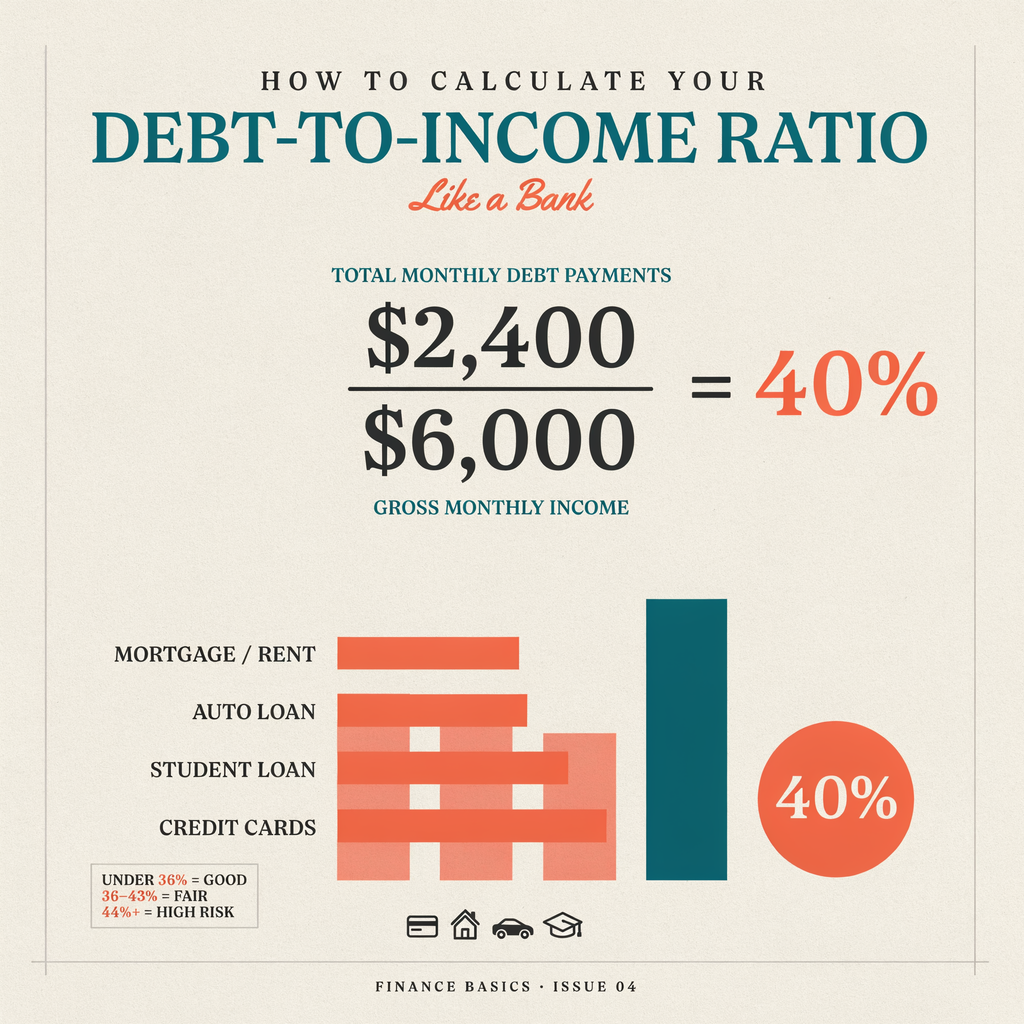
When you apply for a mortgage, auto loan, or major line of credit, lenders look closely at your finances to decide if you can comfortably handle the new payments. One of the most critical metrics they use is the debt-to-income ratio (DTI). Simply put, your DTI is your total monthly debt payments divided by your gross monthly income.
Understanding this number is crucial for first-time homebuyers and anyone preparing to borrow. If your ratio is too high, you might face higher interest rates or outright denial. If it is in a healthy range, you will have significantly more borrowing power and financial flexibility.
In this guide, we will show you exactly how to calculate your debt-to-income ratio just like a mortgage lender. We will break down the formula, explain the difference between front-end and back-end DTI, walk through realistic calculation examples, and share actionable strategies to improve your number before you apply for credit.
What Is a Debt-to-Income Ratio?
A debt-to-income ratio is a personal finance metric that compares how much money you owe each month to how much money you earn. Lenders use it to assess your borrowing capacity and overall repayment risk. It answers a fundamental question: If we lend this person money, will they have enough income left over to cover their existing obligations plus the new loan payment?
It is vital to understand that DTI calculations use your gross monthly income, which is your income before taxes, health insurance premiums, and retirement contributions are deducted. This often surprises consumers who are used to budgeting based on their take-home pay.
Furthermore, your DTI ratio is entirely separate from your credit score, credit utilization rate, or net worth. A person with an 800 FICO score can still be denied a mortgage if their DTI is too high, just as a person with a modest credit score might be approved if their debt load is very low.
The core formula for a DTI calculation is straightforward:
DTI = Total monthly debt payments ÷ Gross monthly income × 100
Front-End vs. Back-End DTI: What Banks Look At
When learning how to calculate debt-to-income ratio for a mortgage, you will encounter two distinct numbers: the front-end DTI and the back-end DTI. Mortgage lenders evaluate both to gauge your financial health.
Front-End DTI (The Housing Ratio)
The front-end ratio focuses exclusively on your housing expenses. It is calculated by dividing your proposed total monthly housing payment by your gross monthly income. For a mortgage, this housing payment includes Principal, Interest, Property Taxes, and Homeowners Insurance (often called PITI). If applicable, it also includes Homeowners Association (HOA) fees and mortgage insurance premiums.
Back-End DTI (The Total Debt Ratio)
The back-end ratio is the broader, more comprehensive metric. It includes your proposed housing payment plus all of your other qualifying monthly debt obligations, divided by your gross monthly income. This is the number most lenders focus on heavily during underwriting, as it represents your total debt burden.
The 28/36 Rule
In traditional personal finance budgeting and conservative mortgage underwriting, you will often hear about the “28/36 rule.” This guideline suggests that your front-end housing costs should not exceed 28% of your gross income, and your back-end total debt should not exceed 36%. However, in today’s lending environment, actual mortgage DTI requirements vary widely. Depending on the loan type (FHA, VA, Conventional), your credit profile, your down payment size, and compensating factors like cash reserves, many lenders will approve back-end DTIs well above 36%, sometimes up to 43% or even 50%.
What Counts as Monthly Debt in a DTI Calculation?
To calculate your DTI accurately, you must know exactly what lenders classify as “qualifying debt.” A common mistake is including everyday living expenses in the calculation. Lenders only care about legally binding, recurring debt obligations that appear on your credit report or court orders.
Debts Typically Included in Your DTI:
- Current housing obligations: Your current rent or mortgage payment.
- Proposed mortgage payment: The estimated PITI, HOA, and mortgage insurance for the home you want to buy.
- Auto loans and leases: Minimum monthly payments for all financed vehicles.
- Student loans: The required monthly payment (even if it is an income-driven repayment plan or deferred, lenders use specific formulas to estimate the payment).
- Credit cards: The minimum required monthly payment listed on your statement, not your total balance.
- Personal loans and installment debt: Any fixed-payment loans.
- Home equity loans or HELOCs: Payments on secondary property liens.
- Child support and alimony: Court-ordered family support payments.
- Co-signed loans: If you co-signed a loan for a family member, it counts against your DTI unless you can prove the primary borrower has made 12 months of on-time payments.
- Financed real estate: Mortgage payments on investment properties or vacation homes.
Expenses That Do NOT Count Toward DTI:
- Groceries and dining out
- Utilities (water, gas, electric)
- Phone and internet bills
- Health, auto, or life insurance premiums
- Childcare or daycare costs
- Transportation costs (gas, maintenance, public transit)
- Entertainment and subscription services (Netflix, gym memberships)
- 401(k) or retirement contributions
How to Calculate Your Gross Monthly Income
Your DTI is only as accurate as the income figure you use. Lenders look at stable, reliable, and documentable income. Here is how to calculate gross monthly income based on your employment status:
- Salaried Employees: Take your annual base salary and divide it by 12. (e.g., $78,000 / 12 = $6,500 gross monthly).
- Hourly Workers: Multiply your standard weekly hours by your hourly rate, multiply by 52 weeks, and divide by 12 months.
- Self-Employed Borrowers: Lenders typically look at your net income (after business expenses) from your last two years of tax returns, add them together, and divide by 24 months.
- Variable Income (Bonuses, Overtime, Commissions): This income can only be included if you have a two-year history of receiving it and it is likely to continue. Lenders will average it over the past 24 months.
- Other Income: Social Security, pensions, disability, and documented rental income can be included, provided you have the award letters or tax documents to prove it will continue for at least three years into the future.
Always base your calculations on the income you can prove via pay stubs, W-2s, and tax returns.
Step-by-Step: How to Calculate Debt-to-Income Ratio
Ready to run the numbers? Follow this seven-step process to calculate your DTI exactly like a bank.
- Calculate your gross monthly income.
- List every qualifying monthly debt payment (using minimums for credit cards).
- Add your proposed housing payment (if applying for a mortgage).
- Sum up all monthly debt payments.
- Divide the total debt by your gross monthly income.
- Multiply by 100 to get your percentage.
Example 1: Renting and Applying for a Mortgage
Let’s look at a realistic scenario.
- Gross monthly income: $6,500
- Proposed mortgage payment (PITI + HOA): $1,800
- Car loan payment: $420
- Student loan payment: $250
- Credit card minimum payments: $130
Front-End DTI Calculation:
$1,800 (Housing) ÷ $6,500 (Income) = 0.276 × 100 = 27.7%
Interpretation: This is excellent. It falls right in line with the traditional 28% guideline for housing costs.
Back-End DTI Calculation:
Total Debt = $1,800 + $420 + $250 + $130 = $2,600
$2,600 (Total Debt) ÷ $6,500 (Income) = 0.40 × 100 = 40%
Interpretation: A 40% back-end DTI is slightly above the old 36% rule of thumb, but it is well within the acceptable limits for most modern conventional and FHA mortgage programs. This borrower is in a strong position for mortgage approval.
Example 2: Improving DTI Before Applying
Imagine a borrower with a gross monthly income of $6,000 and total monthly debts of $2,700. Their back-end DTI is 45% ($2,700 ÷ $6,000). This might restrict their loan options.
However, the borrower has a personal loan with a $300 monthly payment and a remaining balance of $2,500. They use some savings to pay off the personal loan completely before applying for the mortgage.
- New Total Debt: $2,400 ($2,700 – $300)
- New Back-End DTI: $2,400 ÷ $6,000 = 40%
By eliminating one small debt, the borrower dropped their DTI by 5%, potentially saving thousands in interest or securing approval on a better loan program.
What Is a Good Debt-to-Income Ratio?
While lender underwriting guidelines vary, the mortgage industry generally views DTI tiers as follows:
| DTI Percentage | Lender Perspective & Borrower Impact |
|---|---|
| Below 36% | Strong. You have a healthy balance of debt and income. You will easily qualify for most loan types and likely receive the best interest rates. |
| 36% to 43% | Acceptable. This is the sweet spot for many modern borrowers. You will qualify for most conventional, FHA, and VA loans, assuming your credit score and down payment are solid. |
| 43% to 50% | Borderline/Restricted. Approval is harder. You may need to utilize specific FHA or non-qualified mortgage (Non-QM) programs. You might face higher interest rates or be required to make a larger down payment. |
| Above 50% | High Risk. Most mainstream lenders will deny the application. You will likely need to aggressively reduce debt, increase income, or look for a less expensive home. |
Remember, these are benchmarks, not universal laws. A borrower with a 45% DTI, an 800 credit score, and 12 months of cash reserves may be approved, while a borrower with a 40% DTI and a 620 credit score might be denied.
How DTI Affects Mortgage Approval and Loan Options
Your debt-to-income ratio is a cornerstone of “Ability-to-Repay” (ATR) rules and mortgage underwriting. It dictates not just if you get a loan, but what kind of loan you get.
If your DTI is high, lenders view you as a higher risk. To offset this risk, they may offer you a higher interest rate, which costs you significantly more over the life of the loan. Alternatively, they might approve you for a smaller loan amount than you requested, forcing you to increase your down payment or lower your price range. In the worst-case scenario, a high DTI leads to outright denial.
Conversely, a lower DTI ratio signals financial stability. It improves your affordability, gives you leverage to negotiate better terms, and provides a cushion against unexpected financial hardships. While lenders do allow exceptions for high DTIs—often requiring “compensating factors” like massive cash reserves or a very low loan-to-value (LTV) ratio—you should never assume an exception will be made.
How to Lower Your Debt-to-Income Ratio Before Applying
If your DTI calculation is higher than you would like, do not panic. You have several practical tactics to improve your profile before you apply for a mortgage or major loan:
- Pay down credit card balances: Because lenders use the minimum payment for DTI, lowering your balances will lower your minimums, instantly shrinking your back-end DTI.
- Avoid new debt: Do not finance a new car, buy furniture on credit, or open new store cards in the months leading up to your application.
- Pay off small installment loans: If you have a small personal loan or credit card that is almost paid off, clearing it completely removes that monthly obligation from your DTI.
- Adjust your home search: Choosing a less expensive home lowers your proposed property taxes, insurance, and principal/interest, which directly improves your front-end and back-end DTI.
- Increase documented income: If you are eligible for a raise, or if you can take on a documented, stable side hustle, increasing the denominator of the DTI formula lowers the overall percentage.
- Avoid co-signing: Never co-sign a loan for a friend or family member while preparing to buy a house; their debt will count against you.
- Protect your reserves: Do not drain your emergency savings just to pay off a low-interest car loan. Lenders highly value cash reserves (money left in the bank after closing).
- Check your credit report: Dispute any errors, such as paid-off loans still showing an active monthly payment or accounts that do not belong to you.
Common DTI Calculation Mistakes to Avoid
When running your own numbers, consumers frequently make errors that lead to false confidence or unnecessary anxiety. Avoid these common pitfalls:
- Using take-home pay: Always use gross (pre-tax) income. Using net income will make your DTI look artificially high.
- Forgetting the proposed mortgage: If you are renting and buying a house, your current rent goes away, but the new PITI payment must be included.
- Using full credit card balances: Only the minimum payment listed on your statement counts.
- Omitting “invisible” debts: Forgetting to include student loans in deferment, alimony, or co-signed loans will result in a nasty surprise during underwriting.
- Counting living expenses: Do not factor in utilities, groceries, or childcare.
- Assuming identical limits: Do not assume that because a friend was approved with a 48% DTI, you will be too. Every loan program and borrower profile is different.
Frequently Asked Questions
What is a good DTI ratio for a mortgage?
Generally, a back-end DTI below 36% is considered excellent, while anything up to 43% is widely acceptable for most conventional and government-backed mortgage programs.
Does rent count toward DTI?
If you are currently renting and applying for a mortgage, your current rent is usually not factored into the final DTI calculation, as it will be replaced by your new proposed mortgage payment. However, if you are applying for a non-mortgage loan (like an auto loan), your current rent may be counted as a housing obligation.
Do credit cards count if I pay them in full each month?
Yes. Even if you never pay a dime in interest and clear your balance monthly, the lender will still use the minimum payment listed on your most recent statement when calculating your DTI.
Can I get a mortgage with a high DTI?
Yes, but it is more difficult. Certain FHA loans allow DTIs up to 50% or slightly higher if you have strong compensating factors, like a high credit score or significant cash reserves. Non-QM loans also cater to high-DTI borrowers but usually come with higher interest rates.
How can I lower my DTI quickly?
The fastest way to lower your DTI is to pay off revolving credit card debt (which lowers your minimum payments) or pay off small installment loans entirely. Increasing your down payment to lower your proposed mortgage payment is also highly effective.
Conclusion
Learning how to calculate your debt-to-income ratio is one of the most empowering steps you can take in your personal finance journey. By calculating both your front-end and back-end DTI exactly like a bank, you remove the guesswork from the borrowing process. You will know precisely what you can afford, which lenders are most likely to approve you, and exactly which debts to target to improve your financial profile. Run the numbers, reduce your qualifying debt where possible, and step into your next loan application with total confidence.