
You’ve spent weeks touring homes, and finally one feels right. Before you can process the listing details, your agent says, “We need to submit an offer in the next twenty minutes, waive the inspection, and go over asking—or you’ll lose it.” Your stomach drops. You wanted a home, not a high-pressure sales pitch.
Or maybe you’re selling. Your listing agent calls with the first offer, urges you to accept it immediately, and can’t clearly explain your net proceeds after closing costs, repairs, and commissions. You nod along, but something feels off.
Buying a house or selling a house often involves hundreds of thousands of dollars. The guidance, communication, and loyalty of your real estate agent can shape your financial outcome for years. Most licensed real estate professionals act ethically and genuinely care about their clients’ goals. However, understanding the signs your real estate agent isn’t looking out for your interests helps you ask better questions, protect your investment, and feel confident in one of life’s biggest transactions.
Whether you’re a first-time homebuyer, a repeat buyer, a homeowner preparing to sell, or an investor handling a smaller residential deal, this guide walks you through five warning patterns, what good representation looks like, and practical steps you can take right now.
Disclaimer: Real estate rules, agency disclosures, contract terms, and termination rights vary by state. Nothing in this article constitutes legal advice. Review your specific agreement carefully and consult a qualified real estate attorney or local real estate professional when you need guidance on your situation.
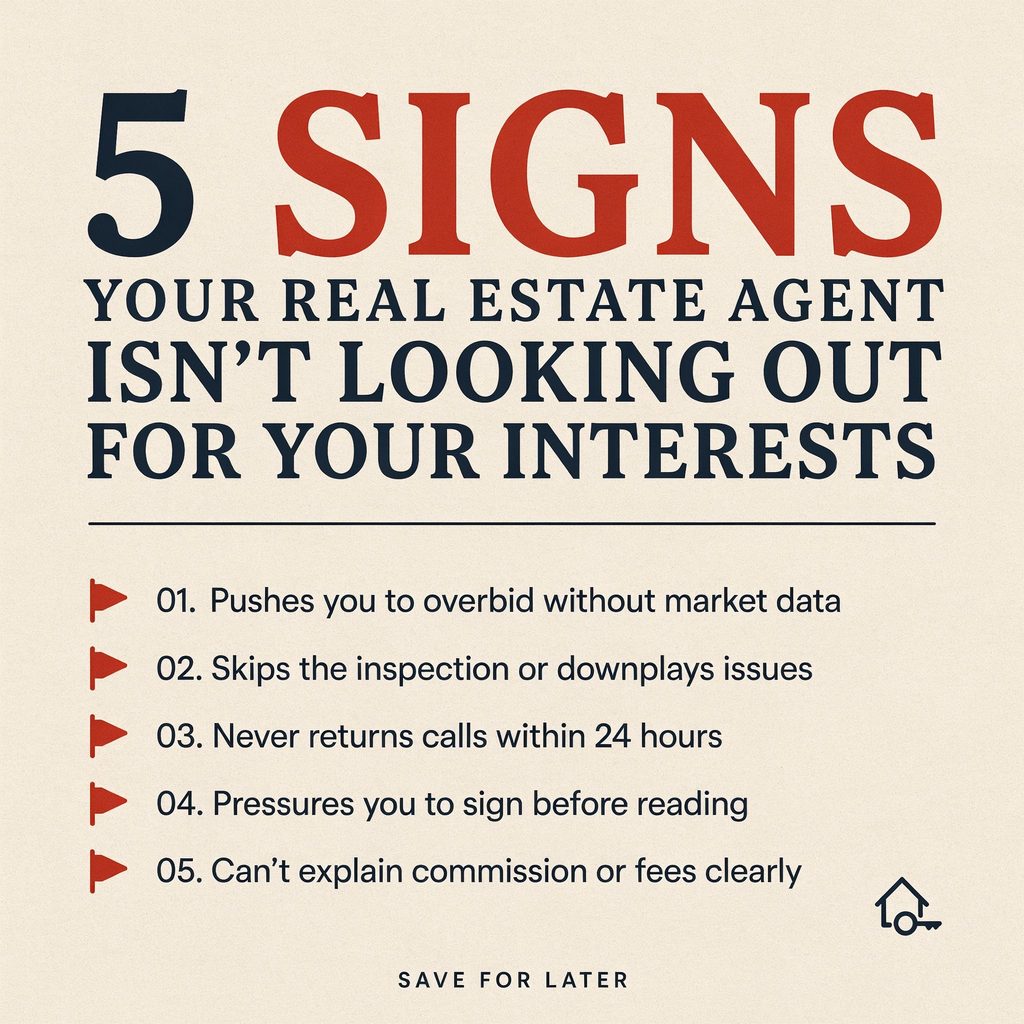
Quick-Reference Table: 5 Warning Signs at a Glance
| Warning Sign | Why It Matters | What You Can Do |
|---|---|---|
| Pressuring you into quick decisions | You may waive protections or accept unfavorable terms | Ask for deadlines in writing; request a comparative analysis before committing |
| Poor or absent communication | Missed updates can cost you money, deadlines, or leverage | Set response-time expectations before signing; escalate to the managing broker if needed |
| Avoiding pricing data or financial details | Overpricing, underpricing, or hidden costs erode your equity | Request a CMA, net sheet, and itemized closing-cost estimate |
| Steering you toward deals that benefit them | Conflicts of interest can limit your options and increase risk | Ask about relationships with vendors; request multiple options |
| Prioritizing commission over your goals | A rushed or unfavorable close may cost you thousands long-term | Clarify fees upfront; remember you control key decisions |
Sign 1: They Pressure You to Make a Quick Decision
Competitive markets are real. When a well-priced property attracts multiple offers, a sense of urgency is natural. A good buyer’s agent will explain the timeline honestly and help you prepare a strong offer without cutting corners you haven’t agreed to.
The real estate agent red flags appear when urgency becomes a weapon:
- Telling you to waive your home inspection contingency, financing contingency, or appraisal contingency without walking through the specific risks.
- Pushing a seller to accept the first offer without reviewing price, contingencies, financing strength, closing timeline, or seller net proceeds.
- Discouraging you from viewing additional homes, comparing offers side by side, reading the purchase agreement, or consulting a family member.
- Using fear-based language—”If you don’t sign tonight, you’ll lose everything”—without evidence.
- Making you feel guilty for wanting twenty-four hours to think.
What you can do instead: Ask for the offer deadline in writing. Request a comparative market analysis (CMA) so you understand fair market value. Ask your agent to explain the pros and cons of every contingency and contract term. A trustworthy agent welcomes those questions.
Sign 2: They Do Not Communicate Clearly or Return Messages
Communication is the backbone of real estate representation. You don’t need a text at midnight, but you should know how and when your agent will update you—especially once you’re under contract.
Bad realtor signs in this area include:
- Repeatedly ignoring calls, texts, or emails during an active transaction.
- Failing to share updates about showings, buyer feedback, inspection results, appraisal outcomes, loan milestones, or closing changes.
- Giving vague answers like “It’s being handled” instead of clear explanations.
- Not sending key documents—agency disclosure forms, the purchase agreement, addenda, or disclosure statements—promptly.
- Leaving you blindsided by deadlines, closing costs, or schedule shifts.
Before you hire an agent, ask practical questions: “What is your typical response time?” “Will I work directly with you or a team member?” “How will you update me after showings?” “Who handles communication if you’re unavailable?”
A strong agent translates complex real estate terms into plain English and never makes you feel embarrassed for asking a follow-up question.
Sign 3: They Avoid Discussing Pricing, Market Data, or the Financial Details
Good real estate advice rests on local market data, not guesswork.
For sellers: A listing agent should present a comparative market analysis showing recent comparable sales, active competition, average days on market, property-condition adjustments, and seasonal demand. They should provide an estimated net sheet so you understand what you’ll actually pocket after the real estate commission, seller concessions, closing costs, and any agreed-upon repairs. Overpricing a home simply to win your listing often leads to fewer showings, longer market time, price reductions, and weaker negotiating power.
For buyers: Your buyer’s agent should help you evaluate a home’s list price against comparable sales, neighborhood trends, potential repair costs, property taxes, homeowners association fees, insurance, and resale considerations. They should discuss appraisal risk openly, especially in a hot market.
Warning signs include an agent who suggests a listing price with no supporting data, promises an unrealistically high sale price to secure your listing, discourages you from discussing an appraisal gap, or focuses only on purchase price while ignoring the total cost of ownership.
Remember: The highest offer is not always the best offer. Imagine a seller receives two bids. Offer A is $25,000 over asking but comes with weak financing, a broad inspection contingency, and a sixty-day close. Offer B is $10,000 lower but includes verified pre-approval, a larger earnest money deposit, fewer contingencies, and a three-week closing timeline. The right choice depends on the seller’s priorities and risk tolerance—and a good agent explains that tradeoff clearly.
Sign 4: They Steer You Toward Deals That Benefit Them More Than You
In plain terms, steering means directing a client toward a choice that serves the agent’s convenience, financial interest, or relationships rather than the client’s stated needs. Real estate professionals must also comply with fair housing laws enforced by the U.S. Department of Housing and Urban Development (HUD); directing clients away from neighborhoods based on protected characteristics is unlawful. If you suspect discriminatory conduct, contact HUD or a local fair-housing agency.
Beyond illegal conduct, look for subtler conflicts:
- Repeatedly pushing certain listings without explaining why they match your budget, location, or must-haves.
- Strongly recommending one mortgage lender, home inspector, title company, or contractor while refusing to offer alternatives or disclose a referral relationship.
- Prioritizing in-house listings or transactions where the same brokerage represents both buyer and seller (dual agency) without fully explaining the potential conflicts.
- Recommending a deal that is easier or faster for the agent but misaligned with your timeline, financing needs, or risk tolerance.
- Dismissing legitimate concerns about condition, inspection findings, or long-term resale potential.
Referrals are not inherently bad. Many agents maintain reliable professional networks. The issue arises when there is a lack of transparency, limited choice, or undisclosed financial incentive.
Ask directly:
- “Do you have a financial or business relationship with this provider?”
- “Can you give me several options to compare?”
- “Are there any agency or brokerage conflicts I should understand?”
If you encounter dual agency or designated agency—arrangements that are permitted in some states but prohibited in others—read the required agency disclosure carefully before consenting. The National Association of Realtors (NAR) and your state real estate commission publish guidance on these structures.
Sign 5: They Put Their Commission Ahead of Your Goals
Real estate commissions are a normal part of many transactions, and skilled agents deserve fair compensation. The concern arises when behavior suggests the agent is focused mainly on closing quickly rather than helping you make a sound decision.
Signs include:
- Pressuring a seller to accept a lower offer because it’s “easier to close.”
- Encouraging a buyer to stretch well beyond their comfort level without data-based justification.
- Discouraging real estate negotiation over repairs, credits, price, possession date, or contingencies simply to avoid extra work.
- Becoming noticeably less responsive after you raise concerns or ask to renegotiate.
- Failing to explain the buyer broker commission, listing agreement terms, or any incentives clearly.
- Pressuring you to sign an exclusive buyer representation agreement or listing agreement without giving you time to read it and ask questions.
The best agents help you understand tradeoffs, negotiate assertively, and provide market perspective—but you retain control over whether to make an offer, accept an offer, continue negotiating, or walk away when contractually permitted.
What a Good Real Estate Agent Does
Not every agent exhibits these warning signs—far from it. A client-focused agent:
- Explains agency relationships and required disclosures clearly before you sign anything.
- Learns your budget, priorities, deal-breakers, timeline, and risk tolerance.
- Uses local market data and comparable sales to support pricing and offer recommendations.
- Communicates regularly and meets every important deadline.
- Explains contracts, contingencies, disclosures, inspection issues, and next steps in plain English.
- Provides options and professional guidance without pressure tactics.
- Negotiates assertively while respecting your final decision.
- Discloses conflicts of interest and referral relationships.
- Recommends qualified third-party professionals while allowing you to compare options.
- Keeps you informed from listing or home search through closing day.
What to Do If You Have Concerns
If one or more of the five signs resonate, you don’t have to suffer in silence. Take measured, practical steps:
- Document specifics. Save texts, emails, and voicemails. Note missed deadlines, unanswered questions, and advice that felt off.
- Have a direct conversation. Tell your agent clearly what needs to change. Many issues are misunderstandings that a frank talk can resolve.
- Review your contract. Re-read your listing agreement, buyer representation agreement, agency disclosure, and any termination clause. Note protection periods or procuring-cause language.
- Escalate to the managing broker. If the issue persists, contact the agent’s real estate broker or managing broker. They have supervisory responsibility.
- Consider changing real estate agents. If trust is broken, you have the right to seek new representation. Understand your obligations under the existing contract before signing with someone new.
- Consult a real estate attorney. If there is a contract dispute, suspected misconduct, a fair housing concern, or a significant financial issue, seek local legal counsel.
- File a formal complaint if warranted. Contact your state real estate commission or local Realtor association when concerns are supported by documentation.
Terminating an agreement may carry consequences, including possible fees or disputes over procuring cause. Do not sign a new representation agreement until you understand your obligations under the old one. The Consumer Financial Protection Bureau (CFPB) and Federal Trade Commission (FTC) also publish consumer guidance relevant to real estate transactions and services.
Frequently Asked Questions
How do I know if my real estate agent is representing my interests?
Review the agency disclosure you signed at the start of the relationship. It should state clearly whether the agent represents you, the other party, or both. A good agent reinforces this in conversation, shares relevant market data transparently, and encourages you to ask questions.
Can I fire my real estate agent after signing a contract?
In many cases, yes, but the process depends on the terms of your listing agreement or buyer representation agreement and your state’s laws. Look for a termination clause. If none exists, contact the managing broker. Consult a real estate attorney before acting if significant obligations remain.
What is a real estate agent’s fiduciary duty?
In most states, an agent who represents you owes duties that commonly include loyalty, confidentiality, disclosure, obedience to lawful instructions, reasonable care, and accounting. The exact scope varies by jurisdiction. Your state real estate commission’s website typically outlines these obligations.
Is dual agency bad for buyers and sellers?
Dual agency—where one agent or brokerage represents both sides—is legal in some states and prohibited in others. Where permitted, it limits the agent’s ability to advocate aggressively for either party. Read the disclosure carefully and consider whether you’re comfortable with reduced advocacy before consenting.
Should I use the lender my real estate agent recommends?
You are never obligated to use a recommended lender. Referrals can be convenient, but you should compare rates, fees, and service from at least two or three lenders. Ask your agent whether they receive any compensation or have a business relationship with the recommended provider.
What should I do if my realtor is pressuring me to waive an inspection?
Pause. Ask the agent to explain, in writing, the specific risks of waiving the home inspection contingency given the property’s age, condition, and disclosures. Consult a licensed home inspector or real estate attorney before deciding. You have the right to protect yourself.
Can I talk to my real estate agent’s broker about a problem?
Yes. The managing broker supervises agents within the firm and can mediate concerns, reassign representation, or clarify contract terms. Bring documentation so the conversation stays focused and productive.
Final Thoughts
Buying or selling a home is too significant to navigate with someone who leaves you feeling ignored, rushed, uninformed, or pressured. Recognizing the signs your real estate agent isn’t looking out for your interests isn’t about assuming the worst—it’s about protecting the largest financial decision most people will ever make.
Trust documented facts over vague reassurances. Ask direct questions and expect clear answers. And remember: a good agent earns your confidence through transparency, data, and respect for your goals—not through urgency, guilt, or silence.
Before you sign a listing agreement or buyer representation agreement, interview more than one agent. Compare communication styles, local expertise, and how each candidate plans to protect your interests throughout the transaction. Your home, your money, and your timeline deserve an advocate who treats all three with the seriousness they warrant.
This article is for informational purposes only and does not constitute legal, financial, or real estate advice. Laws governing agency relationships, disclosures, commissions, and contract termination vary by state. Consult a licensed real estate attorney or your state real estate commission for guidance specific to your situation.