
Why the Difference Matters
Imagine this scenario: You are excited to start house hunting, so you reach out to a real estate agent or a mortgage lender. Almost immediately, they ask if you are “pre-qualified” or “pre-approved.” If you are a first-time homebuyer or even a repeat buyer, you might wonder if these terms mean the exact same thing.
While the real estate industry often uses these phrases interchangeably, the pre-qualified vs pre-approved distinction actually represents different levels of financial review. Understanding the difference between pre-qualified and pre-approved can help you set a realistic budget, prepare a stronger offer, and avoid unpleasant financial surprises during the homebuying process.
In this guide, we will break down:
- What mortgage pre-qualification means.
- What mortgage pre-approval means.
- How the two processes differ.
- Which documents lenders may request.
- How each option affects your home offer.
- Why neither one guarantees final mortgage approval.
What Is Mortgage Pre-Qualification?
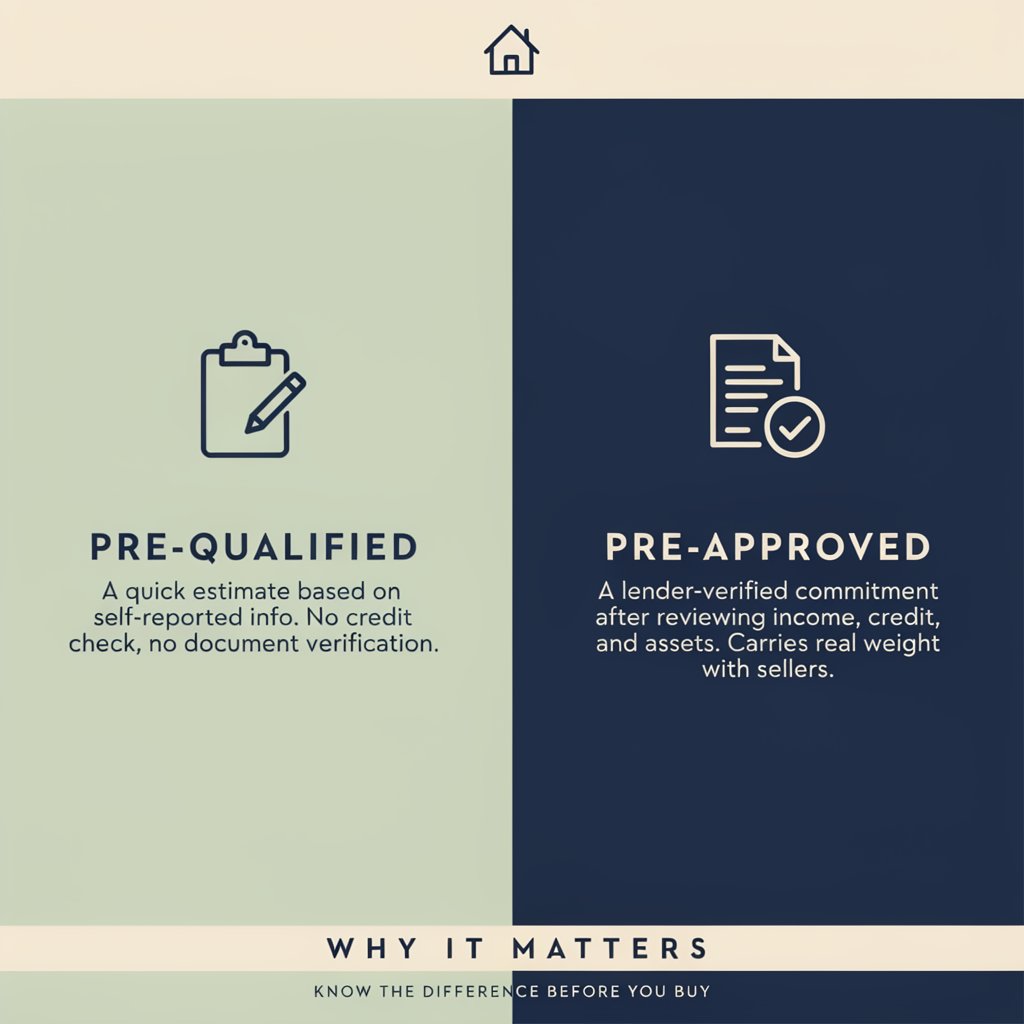
Mortgage pre-qualification is generally an initial, high-level assessment of your financial situation. In plain English, a mortgage lender uses information supplied directly by you—such as your estimated income, monthly debts, total savings, general credit range, and intended down payment—to provide an approximate borrowing amount. Pre-qualification helps you understand your general purchasing power before committing to a hard credit pull, giving you a safe space to explore different neighborhoods and price points.
Typical characteristics of the mortgage pre-qualification process include:
- Speed and Convenience: It is often quick and may be completed online, over the phone, or during a brief initial conversation.
- Limited Documentation: You usually do not need to upload extensive paperwork.
- Self-Reported Data: The information is typically provided by the borrower and not fully verified by the lender at this stage.
- Credit Inquiries: Some lenders may perform a soft credit inquiry, while others may not check your credit score at all.
- Early Estimate: It provides a rough idea of how much house you can afford rather than a final lending decision.
- Output: The result is often a pre-qualification letter or simply an informal estimate.
It is important to clarify that lenders use this terminology differently. Some mortgage lenders may offer a more detailed pre-qualification that includes basic income and credit verification. Because of this, you should always ask exactly what the lender reviewed before relying on a pre-qualification letter to make financial decisions.
What Is Mortgage Pre-Approval?
Mortgage pre-approval is generally a much more thorough preliminary review of a borrower’s financial profile. To issue a home loan pre-approval, a lender typically collects official documents, evaluates your credit history, verifies your income and assets, reviews your debts, and estimates the specific loan amount you may qualify for. During underwriting, the lender will scrutinize your financial history to ensure you meet the specific guidelines of your chosen loan program, whether that is a conventional loan or a government-backed option.
A standard mortgage pre-approval process may include:
- A completed, official loan application.
- A comprehensive credit report and credit score review.
- Verification of employment and income.
- Recent pay stubs, W-2 forms, tax returns, and other income records.
- Bank statements and proof of assets.
- Detailed information about debts and recurring financial obligations.
- An estimated loan amount and debt-to-income ratio calculation.
- A possible mortgage interest rate or rate range.
- A pre-approval letter that is subject to conditions and further underwriting.
A pre-approval is significantly stronger than a basic estimate, but it is crucial to understand that it is not the same as final loan approval. The lender still needs to evaluate the specific property (via an appraisal), verify your information again, complete full underwriting, and satisfy all loan conditions before closing. The Consumer Financial Protection Bureau (CFPB) explicitly states that pre-qualification and pre-approval letters are not guaranteed loan offers.
Pre-Qualified vs. Pre-Approved: Key Differences
When comparing a pre-qualified vs pre-approved mortgage, the main difference lies in the depth of the lender’s investigation. Below is a comparison table highlighting the core distinctions.
| Category | Mortgage Pre-Qualification | Mortgage Pre-Approval |
|---|---|---|
| Purpose | Early estimate of borrowing power | More detailed preliminary lending review |
| Information used | Usually borrower-provided information | Verified financial and credit information |
| Documentation | Often limited or unavailable | Commonly includes income, asset, and debt documents |
| Credit check | May involve no check or a soft inquiry, depending on lender | Often involves a credit check, which may be hard or soft depending on the lender |
| Accuracy | General estimate | More realistic estimate of potential loan amount |
| Speed | Often available quickly | May take several days or longer |
| Letter strength | May carry less weight with sellers | Usually demonstrates greater financing readiness |
| Guarantee | Does not guarantee a mortgage | Does not guarantee final loan approval |
| Best use | Early budgeting and exploration | Preparing to make a serious offer |
Remember that the exact process varies significantly by lender and loan program. Do not assume as an absolute rule that every pre-qualification uses a soft credit check, or that every pre-approval requires a hard inquiry. Always ask your specific mortgage lender about their unique requirements for conventional loan, FHA loan, VA loan, or USDA loan programs.
How the Pre-Qualification Process Works
If you are just starting to figure out how much house you can afford, the mortgage pre-qualification process is straightforward:
- Contact a Professional: Reach out to a mortgage lender, bank, credit union, or mortgage broker.
- Share Basic Information: The lender asks for basic details about your income, debts, savings, credit, and down payment funds.
- Receive an Estimate: The lender calculates your potential borrowing range based on your debt-to-income ratio and self-reported data.
- Get a Letter: The lender may issue a pre-qualification letter outlining the estimate.
- Begin Planning: You use the estimate to begin budgeting and researching homes in your target areas.
Keep in mind that buyers should not automatically shop at the maximum amount shown on the letter. You must also factor in property taxes, homeowners insurance, private mortgage insurance (PMI), homeowners association (HOA) fees, routine maintenance, and utilities, all of which can significantly increase your actual monthly payment.
How the Pre-Approval Process Works
If you are wondering how to get pre-approved for a mortgage, the process requires more effort than a simple estimate:
- Choose a Mortgage Lender: Select a reputable lender or loan professional.
- Complete an Application: Fill out a formal mortgage application.
- Authorize Credit Review: Give the lender permission to pull your credit report.
- Submit Financial Documents: Upload or provide the necessary paperwork.
- Verification: Allow the lender to verify your income, employment, assets, and debts.
- Receive the Letter: Get an estimated loan amount and your official pre-approval letter.
- Review the Details: Check the letter’s expiration date, loan type, specific conditions, and estimated terms.
- Update as Needed: Inform the lender immediately if your financial circumstances change.
During this phase, lenders may ask for additional documents, explanations for large bank deposits, proof of gift funds, detailed information about self-employment income, or specific documentation related to student loans and other debts.
What Documents Are Needed for Mortgage Pre-Approval?
To complete income verification and proof of assets, you will need to provide a paper trail. Keeping digital copies of all these documents in a secure, organized folder can drastically speed up the mortgage pre-approval process and reduce back-and-forth emails with your loan officer. A practical checklist for a first-time homebuyer mortgage or repeat buyer loan may include:
- Government-issued photo identification.
- Recent pay stubs covering the last 30 days.
- W-2 forms from the past two years.
- Federal tax returns, when requested (especially for self-employed borrowers).
- Recent bank and investment account statements (usually the last two months).
- Proof of employment or employer contact information.
- Statements for credit cards, auto loans, student loans, and personal loans.
- Documentation of alimony or child support, if applicable.
- Proof of down payment funds and closing costs.
- Gift letter documentation, if a family member is contributing money.
- Business records and profit-and-loss statements for self-employed borrowers.
- Legal documents related to divorce, bankruptcy, foreclosure, or other major financial events, when applicable.
Requirements differ by lender, borrower profile, and loan type. For instance, a VA loan might require a Certificate of Eligibility, while an FHA loan may have specific rules regarding gift funds.
Does Pre-Qualification or Pre-Approval Affect Your Credit Score?
Many buyers worry about the impact on their credit score. The reality is that the credit impact depends entirely on the type of inquiry performed by the lender. A “soft inquiry” generally does not affect your credit scores, while a “hard inquiry” may cause a slight, temporary dip. You should always ask the lender which type of credit check will be used before applying.
Mortgage applicants often compare multiple lenders to find the best mortgage interest rate. Fortunately, most credit-scoring models group multiple mortgage inquiries made within a short shopping window (typically 14 to 45 days) as a single inquiry to minimize the impact on your score. However, you should confirm how inquiries will be treated.
Additionally, while preparing for a mortgage, avoid opening new credit accounts, taking on large auto loans, making unexplained cash deposits, or closing existing credit cards without first consulting your lender, as these actions can negatively alter your debt-to-income ratio or credit history.
Why Mortgage Pre-Approval Matters to Homebuyers
Securing a home loan pre-approval offers several practical benefits that smooth out the homebuying process:
- Realistic Budgeting: It helps establish exactly how much house you can afford based on verified numbers.
- Agent Confidence: It shows real estate agents that you are a prepared, serious buyer.
- Seller Appeal: It can make your offer much more attractive to sellers who want certainty that the deal will close.
- Speed: It helps you move quickly and confidently in highly competitive markets.
- Early Problem Solving: It identifies documentation errors or credit problems early, giving you time to fix them.
- Clearer Costs: It provides a much clearer estimate of your monthly mortgage costs.
- Comparison Shopping: It helps you accurately compare loan options and lenders.
- Focus: It reduces the risk of falling in love with homes that are completely outside your likely price range.
You might wonder, do sellers prefer pre-approved buyers? Generally, yes. In multiple-offer situations, a seller is much more likely to accept a bid from a buyer whose financing has already been heavily vetted, reducing the risk of the deal falling through. However, clarify your expectations: a pre-approval letter does not make an offer automatically stronger than every competing offer. Sellers also weigh the offer price, contingencies, earnest money deposit, and the proposed closing timeline.
Are You Required to Be Pre-Approved Before Making an Offer?
Rules vary by seller, local market conditions, real estate agent, and the specific property. In extremely hot real estate markets, some listing agents will not even present offers to the seller unless a solid pre-approval letter or proof of funds is attached. In more relaxed markets, you can technically make an offer with just a pre-qualification letter, but sellers may be less confident that the buyer can actually obtain financing.
It helps to understand the hierarchy of homebuying financial documents:
- Pre-qualification letter: An informal estimate.
- Pre-approval letter: A conditional commitment based on verified finances.
- Proof of funds: Documentation showing you have the cash for a cash purchase.
- Loan estimate: A standardized form detailing the projected terms and costs of a specific loan offer.
- Final mortgage commitment: The lender’s official promise to fund the loan, pending final conditions.
- Clear-to-close: The final green light indicating all conditions are met and you can sign closing papers.
Never confuse a pre-approval letter with a guarantee that the loan will close. The property must still appraise for the purchase price, and your financial situation must remain stable.
Which Should You Get First?
Should I get pre-qualified or pre-approved first? The answer depends on your timeline:
- Get pre-qualified when you are still exploring homeownership, estimating general affordability, or casually comparing different lenders.
- Seek pre-approval when you are ready to hire a real estate agent, tour homes seriously, or submit an actual offer.
- Consider requesting pre-approval early if you are preparing to buy in a highly competitive market where speed is essential.
Because some lenders combine the two processes or use different terminology, you must ask clarifying questions:
- What specific information did you verify?
- Was my credit checked, and was it a hard or soft pull?
- How long is this letter valid?
- Is the loan amount conditional?
- What specific events could cause the pre-approval to change or be revoked?
- Does the letter include a locked or estimated interest rate?
- What documents are still outstanding?
- Will I need to be approved again before closing?
Taking these steps ensures you aren’t blindsided by hidden lender requirements or unexpected conditions right before you are scheduled to sign your closing documents.
Common Mistakes to Avoid
Navigating the mortgage process can be tricky. Avoid these common pitfalls:
- Treating a pre-qualification as a guaranteed mortgage.
- Assuming the maximum approved loan amount equals a comfortable, affordable monthly budget.
- Failing to compare multiple lenders and their official Loan Estimates.
- Applying for new credit cards or furniture loans before closing.
- Changing jobs or becoming self-employed without informing your lender.
- Making large, unexplained cash deposits or sudden withdrawals from your bank accounts.
- Spending down the funds needed for your down payment or closing costs.
- Ignoring the ongoing costs of property taxes, HOA fees, and homeowners insurance.
- Letting your pre-approval letter expire before finding a home.
- Assuming all lenders define “pre-approved” in the exact same way.
- Making an offer before fully understanding the loan’s underwriting conditions.
- Forgetting that the physical property itself must also meet lender requirements and pass an appraisal.
Example: How the Difference Works
To illustrate the difference between pre-qualified and pre-approved, consider this simple fictional example:
A buyer reports an annual income of $90,000, monthly debts of $800, savings of $35,000, and a planned 10% down payment. Based on this initial, self-reported information, a lender provides a rough pre-qualification estimate that the buyer can afford a home up to $350,000.
However, during the pre-approval phase, the lender verifies the buyer’s income via tax returns, reviews bank statements, checks the official credit history, confirms the exact debts, and examines the source of the down payment funds. The lender discovers an undisclosed auto loan and a slightly lower credit score than the buyer estimated. After reviewing the verified documentation, the lender issues a pre-approval for $315,000 because the verified debt-to-income ratio and credit profile do not match the original estimate.
This example shows exactly why buyers should treat pre-qualification as an early planning tool and pre-approval as a more reliable—though still conditional—assessment.
Frequently Asked Questions
1. Is pre-approval better than pre-qualification?
Yes, practically speaking. Pre-approval involves verifying your income, assets, and credit, making it a stronger indicator of your borrowing power. Sellers favor pre-approval because it proves financial readiness, whereas pre-qualification is merely an unverified estimate.
2. Does pre-qualification affect your credit score?
Usually, no. Pre-qualification typically relies on a soft credit inquiry or self-reported data, which does not impact your score. Always ask your lender whether they perform a soft or hard pull before providing your Social Security number.
3. Does mortgage pre-approval guarantee a loan?
No. A pre-approval letter is a conditional commitment, not a guarantee. Final approval depends on a satisfactory property appraisal, clear title, stable finances, and full underwriting approval after the letter is issued.
4. Can you make an offer with a pre-qualification letter?
Technically yes, but it is not recommended. In competitive markets, sellers often ignore offers backed only by pre-qualification because it lacks verified financial proof. A pre-approval letter or proof of cash funds is much more effective.
5. How long does mortgage pre-approval take?
The timeline varies by lender and how quickly you submit documents. With automated systems and prompt paperwork, you might receive a letter in 24 to 48 hours. Otherwise, it may take several days to fully verify your profile.
6. What documents are needed for mortgage pre-approval?
Lenders typically require recent pay stubs, two years of W-2s and tax returns, and two months of bank statements. You also need a government-issued ID, proof of employment, and documentation for other debts or assets.
7. How long does a pre-approval letter last?
Most pre-approval letters are valid for 60 to 90 days. This expiration exists because your finances and credit can change. If you haven’t found a home by then, you must update your documents to get a new letter.
8. Can I get pre-approved by multiple lenders?
Yes, and shopping around is highly recommended to find the best rate. Credit scoring models usually group multiple mortgage inquiries made within a 14- to 45-day window as a single inquiry, minimizing the impact on your credit score.
9. Does pre-approval lock in my mortgage interest rate?
Generally, no. Pre-approval provides an estimated rate, but does not lock it. A rate lock usually happens later, once you have an executed purchase contract on a specific property and are nearing closing.
10. What happens after mortgage pre-approval?
After receiving your letter, you can confidently tour homes and make offers. Once accepted, the lender orders an appraisal, finalizes underwriting, issues a Closing Disclosure, and schedules your closing date while you maintain your financial status.
11. Can I be denied after being pre-approved?
Yes. Denial can occur if your finances change—like losing a job or taking on new debt. The loan can also fail if the home appraises below the purchase price or if title issues arise during underwriting.
12. Should first-time homebuyers get pre-qualified or pre-approved?
First-time buyers should seek pre-approval before seriously house hunting. While pre-qualification satisfies early curiosity, pre-approval educates you on true costs, identifies credit issues early, and provides the negotiating power needed to secure a home.
Conclusion
Ultimately, understanding the pre-qualified vs pre-approved distinction is a vital step in the homebuying process. Pre-qualification is a useful tool for early planning and estimating your potential borrowing power. Pre-approval, however, generally involves rigorous documentation and gives buyers a much clearer, more reliable picture of their financing readiness.
As you navigate this journey, remember to compare multiple lenders, carefully understand the conditions attached to any letter you receive, budget comfortably below your maximum approval amount, and consult a qualified mortgage professional before making major financial decisions.
If you are preparing to buy a home, start by reviewing your budget and speaking with a lender about whether pre-qualification or pre-approval is the right next step.
Disclaimer: This article is for general educational purposes only and does not constitute personal financial, legal, tax, or mortgage advice. Lender requirements, terminology, and loan programs (including Conventional, FHA, VA, and USDA loans) vary and are subject to change. Always consult with a qualified, licensed mortgage professional regarding your specific financial situation.