
There is nothing quite like the feeling of holding the keys to your very first home. After months of saving for a down payment, navigating the mortgage approval process, and surviving the chaos of closing day, you finally have a place to call your own. You can paint the walls whatever color you want, adopt a large dog, and hang shelves without asking for permission. For many, the transition from renting to owning represents the ultimate American Dream.
However, once the moving boxes are unpacked and the initial excitement settles, a new reality begins to set in. Many first-time homeowner expenses don’t show up on your monthly mortgage statement. While you were laser-focused on principal, interest, and escrow, you may have overlooked the ongoing financial realities of property ownership.
When you are a renter, a leaky roof or a broken water heater is an inconvenience. When you are a homeowner, it is a direct hit to your bank account. The hidden costs of homeownership can catch even the most financially prepared buyers off guard, turning a celebratory milestone into a source of financial stress.
If you are moving from apartment to house, it is crucial to understand that your monthly mortgage payment is only a fraction of the real cost of ownership. To protect your investment and your wallet, you need to understand the true scope of home maintenance costs, build a realistic house maintenance budget, and prepare for the inevitable surprises that come with managing a property.
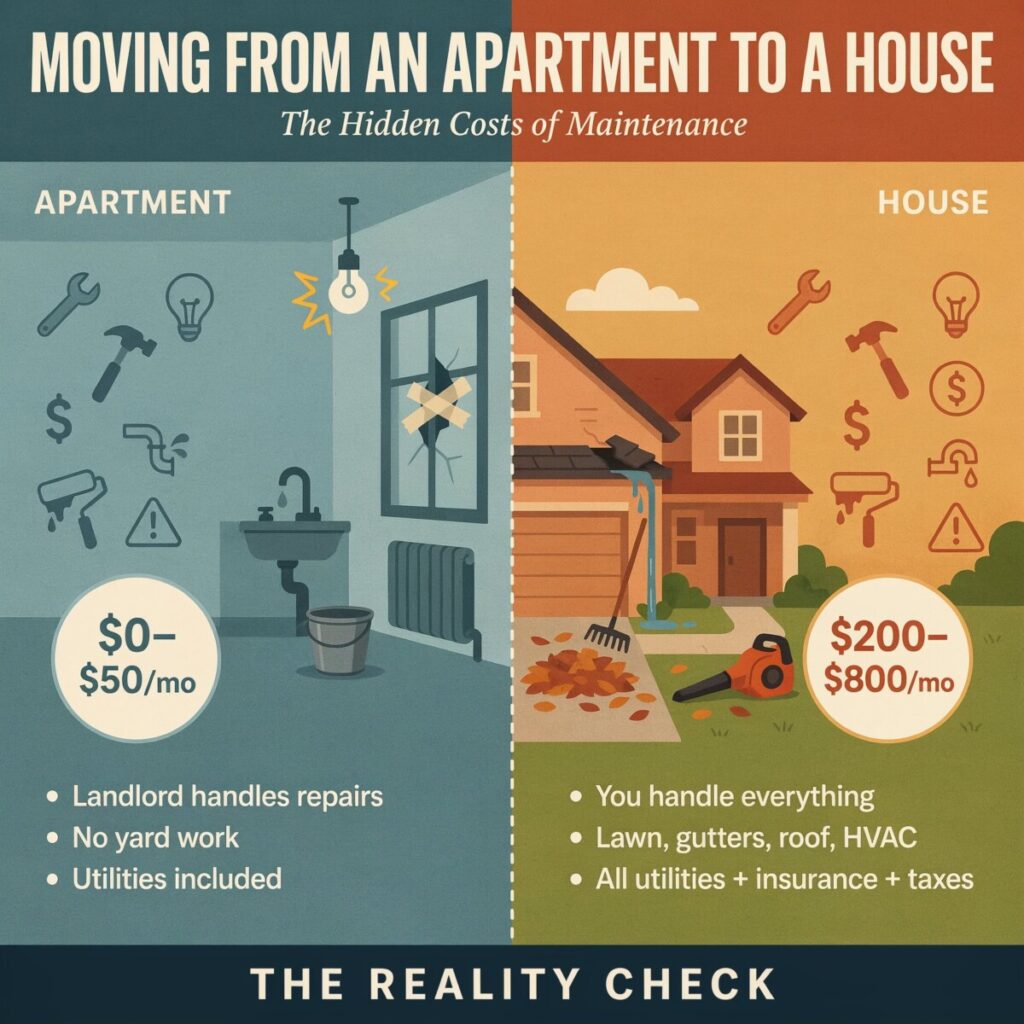
Why Apartment Costs Feel Lower: The “Landlord Shield”
To understand the true cost of owning a home, it helps to look back at your time as a renter. When you live in an apartment or a managed condo, you benefit from what we can call the “Landlord Shield.”
In a rental scenario, property upkeep is entirely outsourced. When the air conditioning stops working in the middle of July, you simply submit a maintenance request. When the kitchen sink clogs or the refrigerator dies, the property manager dispatches a repair technician or replaces the appliance entirely. You might experience a temporary inconvenience, but you rarely have to write a check for the repair.
How Rent Prices Absorb Maintenance
Many renters assume that their monthly rent only covers the “use” of the physical space. In reality, landlords and property management companies price their rentals to cover a wide array of behind-the-scenes expenses. A portion of your monthly rent goes toward:
- Capital Expenditures (CapEx): Long-term savings for major replacements like roofs, siding, and commercial-grade HVAC systems.
- Routine Property Upkeep: Landscaping, snow removal, pest control, and exterior cleaning.
- Unexpected Home Repairs: Plumbers, electricians, and appliance repair technicians.
- Property Taxes and Insurance: The landlord pays the master insurance policy and local taxes, baking those costs into your rent.
Because these costs are spread out over time and handled by a professional, renters are largely insulated from the volatile world of contractor pricing and emergency service fees.
The Reality of the Apartment to House Transition
The apartment to house transition strips away this safety net. When you buy a single-family home, you instantly become the landlord, the property manager, and the maintenance crew all rolled into one.
There is no maintenance hotline to call at 2:00 AM when your basement starts flooding. You are the one researching emergency plumbers, negotiating quotes, and paying the invoice. Moving into a house means shifting your mindset from a passive consumer of housing to an active manager of a complex, depreciating physical asset. Recognizing this shift is the first step toward building a sustainable homeownership budget.
The Biggest Hidden Maintenance Costs
Home maintenance is not a monolith; it comes in three distinct flavors: routine upkeep, major system replacements, and unpredictable emergencies. Understanding the difference is key to building a resilient financial strategy.
1. Routine Home Maintenance
Routine home maintenance encompasses the recurring tasks required to keep a house functioning smoothly and looking presentable. While these costs are smaller on an individual basis, they add up quickly over the course of a year.
- Lawn Care Costs: In an apartment, landscaping is someone else’s problem. In a house, you are responsible for the grass, the shrubs, and the trees. If you choose to hire a landscaping service, lawn care costs can range from $100 to $300 per month during the growing season. Add in fertilization, weed control, and aeration, and you could easily spend $2,000 to $4,000 a year just on your yard.
- Gutter Cleaning: Clogged gutters can lead to water backing up under your roof shingles and rotting your fascia boards. Professional gutter cleaning typically costs between $150 and $300 and should be done at least twice a year.
- Pest Control: Termites, ants, rodents, and wasps are all threats to a homeowner. Preventative quarterly pest control services usually cost between $150 and $300 per visit.
- Air Filters and Cleaning: Changing your HVAC air filters every 1 to 3 months is mandatory to keep your system running efficiently. Furthermore, deep-cleaning tasks like pressure washing the driveway, siding, and deck are necessary to prevent mold and decay.
2. Major Systems and Components
A house is essentially a collection of complex systems living under one roof. Each of these systems has a finite lifespan, and replacing them represents some of the highest homeowner repair costs you will face.
- HVAC Maintenance and Replacement: Your heating, ventilation, and air conditioning (HVAC) system works incredibly hard. HVAC maintenance requires an annual professional tune-up (around $150 to $250) to keep the system efficient. However, when a furnace or central AC unit reaches the end of its 15-to-20-year lifespan, replacement costs can easily range from $5,000 to over $12,000.
- Plumbing Repairs and Water Heaters: Water heaters typically last 10 to 15 years. When yours inevitably fails, expect to pay between $1,200 and $2,500 for a new unit and installation. Additionally, older homes often require plumbing repairs related to aging pipes, failing sump pumps, or main sewer line issues—a notorious hidden cost that can cost $3,000 to $10,000 to excavate and replace.
- Roof Repairs and Replacement: An asphalt shingle roof lasts about 20 to 25 years. If you buy an older home, you may inherit a roof near the end of its life. Minor roof repairs (fixing a few missing shingles or repairing flashing) might cost a few hundred dollars. A full roof replacement on a standard-sized American home, however, routinely costs between $8,000 and $15,000, depending on the materials and pitch of the roof.
- Windows and Siding: Drafty windows or rotting siding impact your home’s energy efficiency and curb appeal. Replacing windows can cost anywhere from $300 to $1,000+ per window.
3. Emergency Home Repairs
Unexpected home repairs are the ones that cause the most financial panic because they rarely give you time to save up for them.
- Appliance Breakdowns: Unlike a rental, the refrigerator, washer, dryer, dishwasher, and stove belong to you. If the compressor on your fridge dies on a Tuesday, you must buy a new one by Wednesday to save your groceries. Budgeting $1,500 to $3,000 every few years for appliance rotation is a smart move.
- Water Damage and Leaks: A slow leak under a bathroom sink can rot the subfloor and breed black mold over time. A burst pipe during a deep winter freeze can cause catastrophic damage in minutes.
- Foundation Issues: If you notice stair-step cracks in your brickwork or doors that no longer close properly, you may have foundation settling. Foundation repairs are highly invasive and notoriously expensive, often costing between $5,000 and $20,000.
- Storm Damage: Heavy winds, hail, and fallen trees can cause sudden damage to your property. While insurance may cover some of this, you are still responsible for the deductible and any immediate tarping or boarding-up required to secure the home.
Annual Budget Expectations: The 1% Rule and Beyond
So, how much money should you actually set aside for these costs? Financial advisors and real estate professionals generally point to the “1% Rule” as a baseline for annual home maintenance costs.
Understanding the 1% to 4% Range
The standard rule of thumb dictates that homeowners should budget between 1% and 4% of their home’s total purchase price each year for maintenance, repairs, and general property upkeep.
Where you fall on this spectrum depends on several variables:
- Age of the Home: A newly constructed home will likely sit comfortably near the 1% mark for the first several years, as everything is under warranty and brand new. A home built in the 1970s, however, will likely push you toward the 3% or 4% mark as aging systems require simultaneous replacement.
- Climate and Geography: Homes in areas with harsh, freezing winters endure more stress on roofs, pipes, and heating systems. Homes in humid, subtropical climates face higher risks of mold, wood rot, and termite damage.
- Size and Features: A sprawling 4,000-square-foot home with a pool, a large deck, and mature trees will naturally cost significantly more to maintain than a modest 1,200-square-foot ranch.
Real-World Math: $300,000 vs. $400,000 Homes
Let’s break down what this looks like in real dollars.
For a $300,000 Home:
- At 1% (Newer Home): $3,000 per year (or $250 per month). This might cover routine landscaping, a few minor plumbing repairs, and an HVAC tune-up.
- At 2% (Average Home): $6,000 per year (or $500 per month). This allows for one medium-sized replacement (like a water heater or a set of appliances) alongside routine upkeep.
- At 4% (Older Home): $12,000 per year (or $1,000 per month). This prepares you for major capital expenditures, like a new roof or a sewer line replacement.
For a $400,000 Home:
- At 1%: $4,000 per year.
- At 2%: $8,000 per year.
- At 4%: $16,000 per year.
If you are only budgeting for your principal, interest, taxes, and insurance (PITI), a $400,000 home might require an additional $500 to $1,000 every single month just to maintain the physical structure. Failing to account for this in your homeownership budget is one of the most common reasons new buyers feel “house poor.”
Costs New Homeowners Often Forget
Beyond the physical structure of the house, there is a secondary layer of expenses that frequently blindsides those making the apartment to house transition. These are the administrative, logistical, and peripheral costs of managing a property.
Tools, Equipment, and Supplies
When you move into an apartment, you generally only need to buy furniture and basic cleaning supplies. When you move into a house, you need to acquire the infrastructure to maintain it.
- Yard Equipment: You will likely need a lawnmower, a weed whacker, an edger, a leaf blower, and a snow shovel (or snowblower, depending on your region). Outfitting a garage with quality yard equipment can easily cost $1,000 to $2,500 right out of the gate.
- Hand Tools and Ladders: A comprehensive tool set, a heavy-duty extension ladder for gutter cleaning, and a wet/dry shop vac are essential homeowner items.
- Consumables: You are now buying the lightbulbs for the exterior floodlights, the water softener salt, the de-icing salt for the driveway, and the specialized cleaning chemicals for your home’s specific flooring and siding.
The Hidden Shifts in Taxes and Insurance
While property taxes and homeowners insurance are technically part of your monthly escrow payment, they are not static.
- Tax Reassessments: In many US municipalities, when a home changes hands, the local tax authority reassesses the property’s value based on the new purchase price. This can lead to a sudden and significant jump in your annual property tax bill, which your mortgage servicer will eventually pass on to you by raising your monthly escrow payment.
- Insurance Gaps: A standard homeowners insurance policy covers fire, theft, and certain types of water damage (like a burst pipe). However, it explicitly does not cover flood damage or earthquake damage. If you are moving into a flood zone, purchasing a separate FEMA flood insurance policy is an absolute necessity, adding hundreds or thousands of dollars to your annual costs. Furthermore, standard policies do not cover normal wear-and-tear or neglected maintenance. If your roof leaks because it is 30 years old, insurance will not pay to replace it.
Homeowners Association (HOA) Fees
If the home you purchase is in a managed community, you will be subject to HOA fees. While an HOA might cover exterior maintenance, landscaping, and trash removal, the monthly dues can range from $100 to over $500. Furthermore, HOAs are notorious for issuing “special assessments”—surprise bills levied against all homeowners to cover unexpected community repairs, like repaving private roads or replacing the community clubhouse roof.
How to Prepare Financially and Practically
You cannot avoid the hidden costs of homeownership, but you can absolutely prepare for them. Surviving the shift from renting to owning requires a combination of financial strategy and practical, proactive home management.
1. Build a Dedicated Maintenance Reserve
The most important financial step you can take is establishing a maintenance reserve fund. This is a dedicated savings account used exclusively for the house.
Do not mix your home repair savings with your personal emergency fund. Your personal emergency fund is for you—it covers job loss, medical emergencies, or unexpected car repairs. Your maintenance reserve is for the house.
How to fund it: Take the estimated 1% to 2% of your home’s value and divide it by 12. Set up an automatic monthly transfer from your checking account to a high-yield savings account designated for the house. If your monthly mortgage payment is $2,500, try to automatically route an additional $300 to $500 into your maintenance reserve every month. When the water heater dies in year three, you simply pay for it from this account without having to put the expense on a high-interest credit card.
2. Master the Art of Preventive Maintenance
The cheapest repair is the one you never have to make. Preventive maintenance is the practice of servicing your home’s systems before they fail. It is the ultimate antidote to emergency home repairs.
Create a comprehensive, seasonal maintenance checklist and stick to it. Here is a basic framework for US homeowners:
- Spring:
- Inspect the roof for missing or damaged shingles after winter storms.
- Clean out gutters and ensure downspouts direct water at least 5 feet away from your foundation.
- Service the central air conditioning system before the summer heat hits.
- Check exterior caulking around windows and doors to prevent water intrusion.
- Summer:
- Deep clean the deck or patio and apply a fresh sealant to prevent wood rot.
- Inspect the driveway for cracks and seal them to prevent water from freezing and expanding in the winter.
- Trim tree branches away from the roofline and the home’s exterior.
- Fall:
- Hire a professional to inspect and clean the chimney if you have a wood-burning fireplace.
- Schedule an annual HVAC maintenance tune-up for the furnace.
- Drain and store outdoor hoses, and shut off the water supply to exterior spigots to prevent frozen pipes.
- Clean gutters again once the autumn leaves have fallen.
- Winter:
- Monitor the attic for ice dams on the roof edge.
- Check for drafts around windows and apply weatherstripping.
- Test smoke detectors and carbon monoxide detectors (do this bi-annually).
3. Know When to DIY and When to Hire a Pro
As a new homeowner, you will be tempted to watch a YouTube tutorial and fix everything yourself to save money. While DIY is great for painting, changing light fixtures, or basic landscaping, it is incredibly dangerous for complex systems.
Attempting to DIY major electrical work, structural foundation repairs, or main plumbing lines can result in code violations, voided warranties, and catastrophic damage that costs ten times more to fix than if you had hired a licensed professional from the start. Build relationships with reputable local tradespeople—a good plumber, electrician, and HVAC tech are worth their weight in gold.
Conclusion: Embracing the True Cost of Ownership
Moving from apartment to house is a massive lifestyle upgrade. It offers privacy, space, stability, and the incredible opportunity to build long-term equity. However, romanticizing the idea of homeownership without respecting the financial responsibilities that come with it is a recipe for stress.
The hidden costs of homeownership are not meant to scare you away from buying a house; rather, they are realities that demand respect and preparation. By acknowledging that a mortgage is just the starting line, budgeting 1% to 4% of your home’s value for annual home maintenance costs, and building a robust maintenance reserve, you insulate yourself from the shock of unexpected home repairs.
When the water heater eventually gives out, or the roof needs new shingles, you won’t panic. You will simply view it as the cost of doing business as a homeowner. You will write the check from your reserve fund, schedule the repair, and get back to enjoying the beautiful, private sanctuary that you worked so hard to achieve.
Before you sign the closing papers, take a hard look at your homeownership budget. Ensure you are not just buying a house, but financially preparing to maintain a home. Your future self—and your bank account—will thank you.