
Disclaimer: Real estate laws, recording procedures, disclosure requirements, and property-transfer rules vary significantly by state and county. This article is for general educational purposes only and does not constitute individualized legal or financial advice. Always consult a licensed real estate attorney or qualified title professional for guidance on a specific property.
Purchasing a home in the United States involves much more than signing a purchase agreement and receiving the keys. A buyer must also be confident that the seller legally owns the property and possesses the right to transfer it. This is where the concept of the chain of title comes into play.
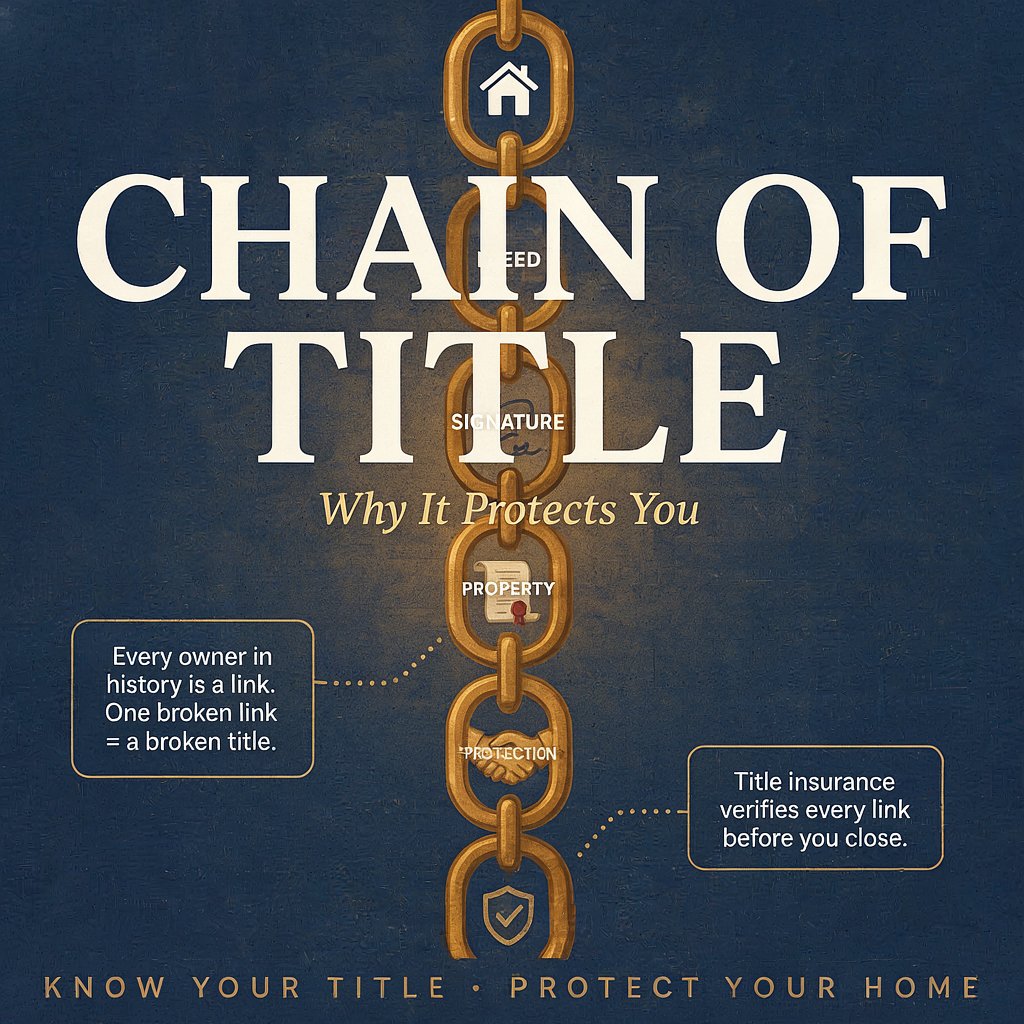
Think of a property’s ownership timeline as a physical chain, where every deed or legal transfer represents one individual link. If a single link is missing, inaccurate, or legally defective, the entire chain weakens. Consequently, a buyer may face severe delays, ownership disputes, financial losses, or difficulty selling the property later.
In this guide, we will explore the definition of a chain of title, how title professionals trace property ownership history, common title defects that cause breaks, the vital role of title insurance, and practical steps buyers can take to protect themselves during a real estate transaction.
What Is a Chain of Title?
In straightforward terms, a chain of title is the chronological record of a property’s historical ownership and the legal instruments that affected it over time. It represents the unbroken sequence of transfers from the current owner back through previous owners.
A complete chain of title encompasses much more than just a list of names. It is a comprehensive historical record that includes:
- Previous property owners (grantors and grantees).
- Deeds and other formal conveyances.
- Transfers caused by inheritance or estate settlements.
- Court judgments and divorce decrees.
- Foreclosures and tax sales.
- Easements, covenants, and other recorded interests.
- Mortgages, liens, and encumbrances that may affect the property.
To understand the chain of title, it helps to clarify a few related real estate terms:
- Title: The legal concept representing your bundle of rights and interests connected to property ownership.
- Deed: The physical legal document used to transfer an interest in real estate from one party to another.
- Chain of title: The historical sequence showing how ownership and related interests passed from one party to another over time.
- Title search: The active investigation of public records to discover this ownership history, alongside any liens, defects, or restrictions.
A proper chain generally connects the current owner to prior owners and, depending on local search requirements, may trace ownership back to an original government land grant or earlier source of title. Each transfer must connect properly to the next and relate to the exact same parcel of land.
Example of a Chain Link:
If Jane purchased a property from Robert in 2018, Robert should appear as the grantor and Jane as the grantee on the recorded deed. If Robert acquired the property from Linda in 2010, the earlier deed should properly identify Robert as the grantee. These connected transactions create solid links in the chain of title.
How the Chain of Title Works in a Real Estate Transaction
Tracing a property’s history is a meticulous process typically handled by a title company, title examiner, abstractor, or real estate attorney. While public records are usually maintained at the county or local level and exact procedures differ across jurisdictions, the general workflow follows these steps:
1. Identify the Property
The examiner begins by confirming the property’s exact identity. This involves verifying the street address, the county parcel identification number (PIN), the current record owner, and most importantly, the official legal description.
2. Locate the Current Deed
The professional reviews the most recently recorded deed in the county recorder’s office to determine who currently appears to own the property and how they took title (e.g., sole ownership, joint tenancy, or through a trust).
3. Trace Previous Transfers
Working backward in time, each current owner is matched with the prior deed or legal instrument that transferred the property to them. The examiner ensures the grantor on the current deed matches the grantee on the previous deed.
4. Compare Legal Descriptions
Street addresses can change or be assigned incorrectly. The examiner ensures the legal description (such as lot and block numbers or metes and bounds) consistently identifies the exact same parcel of land throughout the entire deed history.
5. Search Related Public Records
Ownership is only part of the story. The examiner searches multiple county and local offices for mortgages, releases, judgments, tax liens, mechanics’ liens, probate records, divorce proceedings, bankruptcy filings, easements, neighborhood restrictions, and foreclosure documents.
6. Identify Gaps or Inconsistencies
The examiner looks for clouds on title. They may flag missing deeds, incorrect names, unreleased mortgages, recording errors, conflicting legal descriptions, or transfers that occurred after an owner’s death without proper probate.
7. Prepare a Title Commitment or Report
Finally, the findings are compiled into a title commitment. Discovered issues are listed as “requirements” (matters that must be resolved before closing) or “exceptions” (matters that will remain excluded from insurance coverage).
Why Chain of Title Matters to Buyers
Why should a buyer care about who owned a house fifty years ago? Because a property’s history directly impacts your future rights, financial security, and ability to sell. Reviewing the chain of title provides several critical benefits:
- Confirms the Seller’s Legal Authority: The chain helps establish whether the seller is the true record owner. You cannot buy a home from someone who does not possess the legal right to convey it.
- Reduces the Risk of Ownership Disputes: A former owner, a missing heir, an ex-spouse, or a forgotten business partner may challenge your ownership if a prior transfer in the chain was legally defective.
- Reveals Liens and Financial Claims: Unpaid property taxes, contractor claims, or judgment liens often attach to the real estate itself, not just the previous owner. If undiscovered, these debts could become your responsibility or trigger a foreclosure.
- Protects Marketability: When you eventually sell the home, your buyer will demand a “marketable title”—a title free of serious defects and reasonable doubts. A well-documented chain ensures your property remains attractive to future buyers.
- Supports Mortgage Approval: Lenders require confidence that their mortgage lien will be properly secured and hold the expected first-priority position against other claims.
- Prevents Expensive Surprises: Discovering a title problem before closing gives the parties an opportunity to correct it, negotiate a price reduction, or walk away from the transaction entirely.
It is important to note that a clear chain of title does not necessarily mean the property has zero restrictions. It simply means the ownership history has been thoroughly examined, and any identified issues have been properly addressed or clearly disclosed.
Common Problems That Break the Chain of Title
A “broken chain of title” occurs when there is a gap, error, or unresolved claim in the property’s historical record. These issues are often referred to as title defects or clouds on title. While not every issue makes a property impossible to buy, unresolved defects can severely delay closing or require expensive legal action.
Common problems include:
- Unrecorded Deed: A transfer occurred between two parties, but the deed was never properly filed in the public records, leaving the official chain incomplete.
- Missing Heir: An owner died, but the estate was not properly settled, or not all legal heirs were included in the property transfer.
- Improper Probate Transfer: Property passed through an estate without the required court documentation or executor authority.
- Incorrect Legal Description: A past deed describes the wrong parcel, omits a section of land, or contains a typo in the boundary measurements.
- Name Variation or Identity Error: A person’s name is misspelled, abbreviated (e.g., “William” vs. “Wm.”), or confused with another individual with the same name.
- Forgery or Fraud: A historical deed, release, or signature was forged or executed by someone impersonating the true owner.
- Unreleased Mortgage: A prior owner paid off their mortgage, but the lender never recorded the formal release or satisfaction of mortgage in the county records.
- Outstanding Tax Lien: Unpaid local property taxes, state taxes, or federal IRS claims remain attached to the property.
- Mechanics’ Lien: A contractor, subcontractor, or supplier claims they were never paid for work or materials used to improve the property.
- Judgment Lien: A court judgment against a previous owner creates a financial claim against their real estate assets.
- Divorce or Marital Interest: A former spouse may retain an ownership claim or spousal interest if a divorce decree did not properly transfer the title.
- Boundary or Easement Dispute: Neighboring property rights, shared driveways, or unrecorded utility access arrangements may conflict with the legal description.
- Foreclosure Problem: In the case of bank-owned (REO) properties, required legal notices or foreclosure procedures may not have been completed correctly.
- Break Caused by a Trust or Entity: A deed may fail to show that the specific trustee, corporation, partnership, or LLC had the legal authority to sign the transfer.
- Adverse Possession: A neighbor or trespasser may assert ownership rights based on long-term, continuous, and open possession of a portion of the land.
A title examiner will distinguish between a correctable issue (like ordering a missing mortgage release), an exception that will remain outside of insurance coverage (like a recorded utility easement), and a serious defect requiring a quiet title lawsuit.
Chain of Title vs. Title Search vs. Title Insurance
Buyers often confuse the historical record with the investigation and the insurance policy. The following table clarifies the distinct roles each plays in a real estate transaction.
| Term | What it means | Main purpose | Who typically handles it |
|---|---|---|---|
| Chain of title | The historical sequence of property ownership and related transfers. | Shows how ownership passed from one party to another over time. | N/A (It is a historical fact, not an action). |
| Title search | The process of reviewing public records. | Finds ownership issues, liens, defects, and restrictions. | Title professional, abstractor, or real estate attorney. |
| Title commitment or report | A preliminary statement of title conditions and exceptions. | Lists what must be resolved before closing and what may be excluded from coverage. | Title insurance company or agent. |
| Owner’s title insurance | An insurance policy purchased for the buyer or owner. | Provides financial coverage and legal defense for certain covered losses and title claims. | Title insurer (Underwriter). |
| Lender’s title insurance | A policy protecting the mortgage lender. | Protects the lender’s financial security interest in the collateral. | Title insurer (Underwriter). |
The chain of title is the historical ownership trail itself. The title search is the active investigation used to examine that trail. Title insurance is entirely different; it provides contractual protection against certain covered title risks. It is subject to policy terms, exclusions, deductibles, and applicable state laws. Title insurance does not cover every problem, so buyers must carefully review what is excluded from their policy.
How Title Insurance Protects You
Even the most thorough title search can miss hidden hazards. Public records may contain clerical errors, documents may have been filed under the wrong name, or fraud may have gone undetected for decades. This is where owner’s title insurance and lender’s title insurance step in.
Title insurance may help protect you against financial losses and legal fees arising from covered issues such as:
- Undisclosed ownership claims from missing heirs or ex-spouses.
- Forged or fraudulent documents in the property’s past.
- Clerical or recording errors made by the county clerk.
- Certain undisclosed liens that were not found during the search.
- Defective prior transfers that invalidate the seller’s right to sell.
However, it is crucial to understand that coverage depends entirely on the specific policy. Before closing, buyers should carefully review:
- Covered Risks: The specific scenarios the insurer agrees to defend and pay for.
- Exclusions: Broad categories of issues the policy will never cover (e.g., eminent domain, zoning laws).
- Schedule B Exceptions: Specific, known encumbrances tied to your exact property, such as a recorded neighborhood covenant or a shared driveway easement, which are excluded from coverage.
- Policy Limits: The maximum financial payout, usually tied to the purchase price.
- Endorsements: Optional add-ons that expand coverage for specific risks, like boundary encroachments or restrictive covenant violations.
A title search attempts to identify and fix problems before closing. Title insurance protects you after closing against covered defects that were hidden, unrecorded, or impossible to discover. Keep in mind that a title policy does not automatically repair a broken chain of title, erase a known Schedule B exception, or guarantee that every neighborhood dispute will be covered.
How to Protect Yourself Before Closing
Navigating property records can be overwhelming, but US homebuyers can take proactive steps to ensure a smooth transaction. Use this practical checklist to protect your investment:
- Order a title search early: Do not wait until the week before closing to begin the title examination.
- Hire reputable professionals: Work with a highly rated title company or a qualified local real estate attorney.
- Read the title commitment: Do not treat this document as routine paperwork. It outlines the legal status of your future home.
- Ask about exceptions: If you see an item listed on Schedule B, ask your title agent or attorney exactly what it means for your property rights.
- Confirm lien releases: Ensure that all prior mortgages, home equity lines of credit, and judgment liens have been officially released.
- Verify signatures: Check that all required owners, spouses, trustees, heirs, or business entity representatives have signed the necessary transfer documents.
- Check the legal description: Verify the parcel information and boundaries, rather than relying solely on the property’s street address or the MLS listing.
- Demand cures for defects: Ask the seller how unresolved title defects will be “cured” (fixed) or paid off prior to the closing date.
- Buy owner’s title insurance: While a lender’s policy is usually mandatory, an owner’s policy is optional in many states but highly recommended for your personal protection.
- Retain your documents: Keep physical and digital copies of the recorded deed, title commitment, closing disclosure, settlement statement, and your final title policy in a secure location.
- Seek legal counsel for complex cases: If the property involves probate, foreclosure, divorce, bankruptcy, inheritance, or a boundary dispute, consult a licensed real estate attorney in your state.
Buyers should avoid signing a final closing package if they do not fully understand the unresolved title issues or exceptions attached to the property.
Example: A Break in the Chain of Title
Imagine a homeowner is selling a property they inherited from their late father. The current deed lists the homeowner as the sole owner. However, the title search reveals that the father’s estate never properly transferred the property through probate, and two other siblings were legally entitled to a share of the inheritance.
The title company flags this broken chain of title and places a strict requirement on the transaction. To proceed, the missing heirs must sign corrective documents, such as quitclaim deeds, or the estate must complete the proper probate steps. While this issue delays the closing process, discovering it before the sale allows the parties to address it legally. Without a proper correction, a future heir could potentially assert a valid ownership claim against the new buyer years down the road.
Frequently Asked Questions
1. Is a chain of title the same as a deed?
No. A deed is the physical legal document transferring ownership. The chain of title is the historical sequence of all past ownership transfers and related legal instruments affecting the property.
2. How far back does a chain of title go?
It varies by jurisdiction. Many title searches review records going back 40 to 60 years, while others trace ownership all the way back to the original government land grant.
3. Who checks the chain of title?
A title examiner, abstractor, or real estate attorney checks the chain by reviewing public records at the local county recorder or clerk’s office.
4. Can I search the chain of title myself?
Yes, by visiting your county records office. However, interpreting complex legal descriptions, historical deeds, and lien releases is difficult without professional real estate training.
5. What happens if the chain of title is broken?
The transaction usually pauses. The seller must cure the defect—perhaps by recording a corrective deed or clearing a lien—before closing can proceed.
6. Does title insurance cover every chain-of-title problem?
No. Policies contain specific exclusions and exceptions. Known defects, unrecorded easements, and certain zoning issues discovered before closing are typically not covered.
7. Can a property be sold with a title defect?
Technically yes, but it is difficult. Most buyers and mortgage lenders require a clear, marketable title and will refuse to close until defects are resolved.
8. Why do lenders require title insurance?
Lenders require a lender’s title policy to protect their financial investment. It ensures their mortgage lien holds priority over other claims against the property.
Conclusion
The chain of title is one of the most important, yet frequently overlooked, safeguards in a real estate transaction. It provides a verifiable ownership timeline, helps reveal hidden financial claims, supports a buyer’s right to receive marketable title, and gives mortgage lenders the confidence needed to fund a loan.
Before purchasing or selling property, ask for a professional title search, review the title commitment carefully, and understand the protections and exclusions in any title insurance policy. If the transaction involves an inheritance, foreclosure, divorce, trust, bankruptcy, or disputed ownership, consult a licensed real estate attorney in the relevant state to ensure your rights are fully protected.