
Imagine two very different Saturday mornings. In the first, you wake up to the sound of birdsong, step onto a sprawling back porch with your coffee, and watch deer graze near the edge of your five-acre property line. In the second, you take a brisk ten-minute walk to a bustling neighborhood café, grab a pastry, and wave to your neighbors before dropping the kids off at a top-rated elementary school just blocks away.
Both scenarios represent the American dream, but the path to achieving them—and the daily realities of living them—are vastly different.
Whether you are a first-time buyer, a growing family, or a remote worker seeking a change of scenery, buying a home in rural areas versus buying a house in the suburbs requires two entirely different playbooks. While suburban buyers often focus on school districts and HOA rules, rural buyers must navigate well water, septic systems, and land surveys.
To help you make the best choice for your lifestyle and budget, we have created the ultimate rural home buying checklist and suburban home buying checklist. Let’s dive into the practical factors, hidden costs, and critical inspections you need to know before you sign on the dotted line.
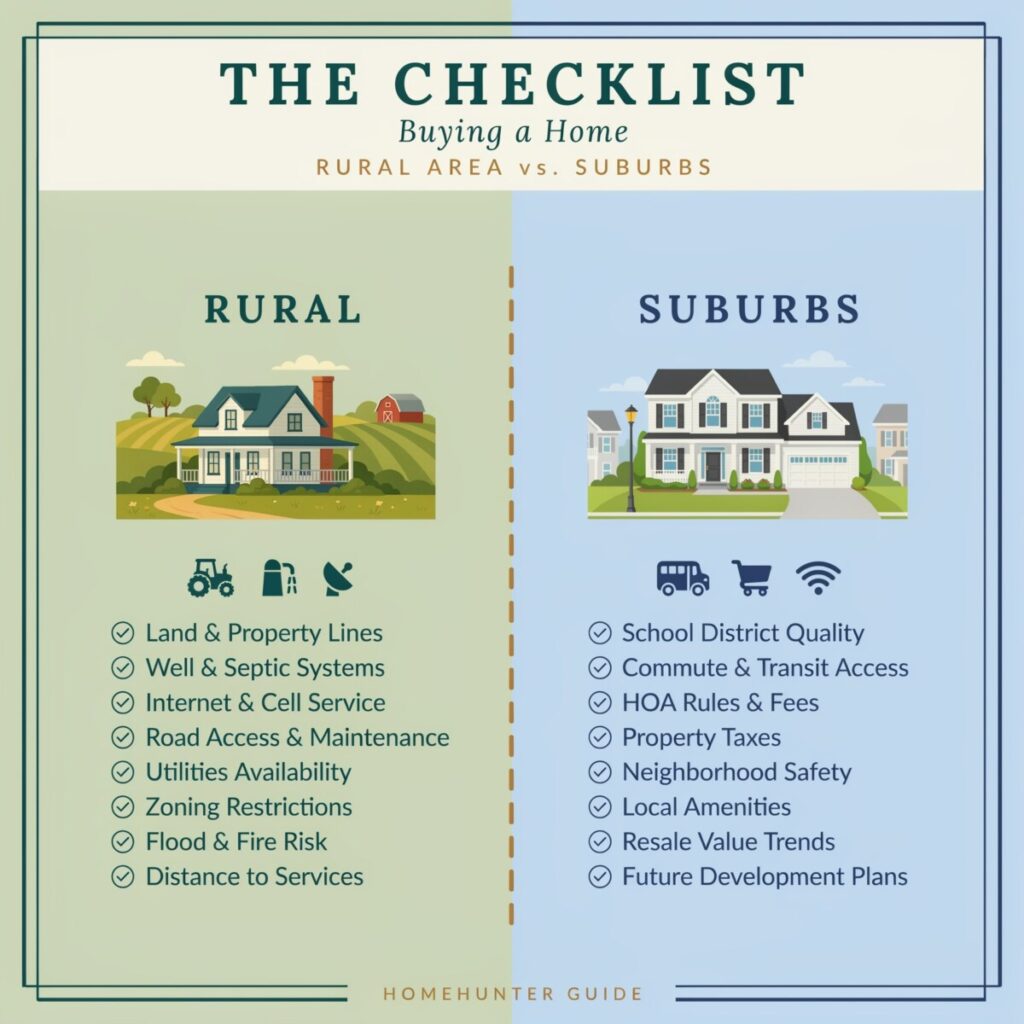
Why Location Matters: Lifestyle & Long-Term Value
The decision between moving to the suburbs vs countryside isn’t just about the house itself; it’s about the friction (or ease) of your daily life. Location dictates your commute time and distance, your access to healthcare, and how you spend your weekends.
Furthermore, location heavily influences long-term financial outcomes. Suburban homes typically benefit from high resale value and market liquidity, meaning they sell quickly due to a large pool of buyers. Rural properties, while offering unparalleled privacy and space, often take longer to sell and appeal to a niche market. Understanding the rural vs suburban cost of living and the day-to-day trade-offs is essential to ensuring you don’t end up house-rich but lifestyle-poor.
Checklist 1: Key Pre-Purchase Research
Before you even attend an open house, you need to research the invisible infrastructure of the area.
Commute and Transportation
- Suburbs: Research peak-hour traffic patterns, access to highways, and public transit availability.
- Rural: Consider seasonal road conditions. A dirt road might be beautiful in July but impassable during spring “mud season” or heavy winter snows. Ask: Who handles driveway and road maintenance? If the road is private, is there a road maintenance agreement with neighbors?
Internet and Connectivity
For remote workers, this is often the ultimate dealbreaker.
- Suburbs: Most neighborhoods are wired for high-speed cable or fiber-optic internet.
- Rural: Broadband internet in rural areas can be spotty or non-existent. You may need to rely on fixed wireless or satellite internet (like Starlink). Always verify the exact address with local ISPs before making an offer.
Local Amenities and Emergency Services
- Suburbs: Grocery stores, pharmacies, and entertainment are usually within a 10-minute drive.
- Rural: A simple trip for milk might require a 30-minute drive. More importantly, investigate the emergency services response time. Many rural communities rely on volunteer fire departments and county sheriffs, which can mean response times of 20 to 45 minutes in an emergency.
Zoning, Land Use, and Restrictions
- Suburbs: Expect strict Homeowners Association (HOA) rules dictating fence heights, exterior paint colors, and parking.
- Rural: Look into zoning and land use regulations. Agricultural zoning might allow you to keep livestock or run a small farm, but it might also mean your neighbor can legally operate a loud, commercial farming operation right next door.
💡 Questions to Ask the Seller/Agent:
- Is the road publicly maintained by the county, or privately maintained by the homeowners?
- Are there any deed restrictions or easements that prevent me from building a barn, workshop, or accessory dwelling unit (ADU)?
Checklist 2: Property & Site Inspections
A standard home inspection is just the tip of the iceberg, especially when looking at acreage. The home inspection checklist rural buyers need is highly specialized.
Water and Waste Systems
- Suburbs: Homes are typically connected to municipal water and sewer. You only need to check the age and condition of the home’s internal plumbing.
- Rural: You are your own utility company. You must order a private well water test to check for flow rate (gallons per minute) and contaminants like bacteria, nitrates, or heavy metals. Additionally, a septic system inspection is mandatory. A failed septic drain field can cost $15,000–$30,000 to replace.
Land, Boundaries, and Acreage
- Suburbs: Property lines are usually clearly marked by fences and sidewalks.
- Rural: Never assume a fence line or tree row marks the property boundary. You must commission an acreage and land survey. This protects you from encroachment disputes and reveals hidden easements (e.g., a neighbor’s legal right to drive across your land to reach theirs).
Environmental and Natural Hazards
- Suburbs: Standard checks for radon, roof condition, and foundation settling.
- Rural: You must check the floodplain map and FEMA data. Rural streams and creeks can flood unpredictably. You should also assess wildfire risk, soil quality (if you plan to garden or farm), and timber/mineral rights. Did the seller retain the mineral rights? If so, a company could theoretically drill on your land in the future.
💡 Questions to Ask the Seller/Agent:
- When was the septic tank last pumped, and do you have the maintenance records?
- Has the well ever run dry during summer droughts?
Checklist 3: Financing, Taxes, and Insurance Differences
The financial mechanics of rural and suburban real estate differ significantly, from the loans you qualify for to the taxes you pay annually.
Financing and Loan Options
- Suburbs: Buyers typically use Conventional, FHA, or VA loans.
- Rural: USDA home loans are a massive advantage for rural buyers. Backed by the U.S. Department of Agriculture, these loans offer 0% down payment and competitive interest rates for buyers in designated rural areas who meet income limits.
Property Taxes and Insurance
- Suburbs: Property taxes rural vs suburban lean heavily toward the suburbs being more expensive. Suburban taxes fund local school districts, trash pickup, and municipal services. Homeowners insurance is generally standard.
- Rural: Property taxes are usually much lower because you receive fewer municipal services. However, homeowners insurance rural homes can sometimes be more expensive. If your home is miles from the nearest fire hydrant or fire station, insurance companies view it as a higher risk and will charge higher premiums.
Resale and Appreciation
Suburban homes generally appreciate steadily and sell quickly due to high demand from families and professionals. Rural properties are subject to resale value and market liquidity fluctuations; they appeal to a smaller buyer pool and can sit on the market for months longer than a suburban tract home.
Checklist 4: Logistics, Utilities & Services After Purchase
Closing on the house is only the beginning. The logistics of moving and setting up your new life require careful planning.
Moving Logistics
Moving to the suburbs vs countryside presents unique physical challenges.
- Suburbs: Moving trucks can easily navigate paved streets, though you may need a permit to park the truck on a busy cul-de-sac.
- Rural: Will a massive 18-wheeler moving truck fit down your winding, tree-lined dirt driveway? Are there weight-limit bridges on the route? You may need to hire a smaller shuttle truck to ferry your belongings from the main highway to your homesite.
Setting Up Utilities and Maintenance
- Suburbs: You call the city to turn on the water, gas, and trash pickup. The HOA handles landscaping of common areas.
- Rural: You must set up propane or heating oil deliveries if natural gas isn’t available. You are responsible for all exterior maintenance, including bush-hogging overgrown fields, clearing snow from a quarter-mile driveway, and managing pest control for wildlife (like deer, bears, or rodents).
Pros, Cons, and Cost Comparison Summary
To help you visualize the trade-offs, here is a quick breakdown of the rural vs suburban cost of living and lifestyle factors.
(Alt text: Comparison chart showing differences in commute, utilities, internet, and maintenance between rural and suburban homes)
| Feature | Suburban Home | Rural Home |
|---|---|---|
| Space & Privacy | Smaller lots, close neighbors | High privacy, expansive acreage |
| Commute | Shorter, access to public transit | Longer, reliant on personal vehicles |
| Water & Sewer | Municipal (city managed) | Private Well & Septic (owner managed) |
| Internet | High-speed Fiber / Cable | Satellite / Fixed Wireless / DSL |
| Property Taxes | Higher (funds schools & services) | Lower (fewer local services) |
| Maintenance | HOA covers common areas | Owner handles all land & road upkeep |
| Emergency Services | 5–10 minute response times | 20–45+ minute response times |
Real-World Case Studies
Case Study 1: Sarah, the Remote Software Engineer
Sarah needed a dedicated home office with gigabit internet and a maximum 45-minute drive to the international airport for her quarterly business trips. She initially looked at buying a home in rural areas to get 10 acres of privacy. However, she realized the lack of fiber-optic broadband and the 90-minute drive to the airport would severely impact her career.
The Compromise: Sarah opted for an exurban/suburban property on a half-acre lot. She sacrificed acreage and absolute quiet to guarantee high-speed internet, quick airport access, and proximity to a major hospital.
Case Study 2: David & Linda, the Retirees
David and Linda wanted to escape the noise of the city, dream of a large vegetable garden, and wanted space for their three large dogs. They utilized USDA home loans to purchase a 15-acre property with 0% down, keeping their retirement savings intact.
The Compromise: They accepted a 40-minute drive to the nearest major medical center. Furthermore, they had to budget for a commercial snowplow service and purchase a tractor for driveway and road maintenance, trading physical convenience for the peace and quiet they desired.
Final Decision Guide: Which is Right for You?
Ultimately, buying a house in the suburbs is ideal if you prioritize convenience, top-tier school districts, low-maintenance living, and fast resale liquidity. Buying a home in rural areas is the perfect fit if you value privacy, space for hobbies (like gardening or keeping animals), lower property taxes, and don’t mind taking on the responsibilities of land stewardship.
Ready to take the next step?
👉 [Download Our Printable Rural vs. Suburban Homebuyer Checklist PDF] to take with you to your next open house!
👉 [Use our Free USDA Loan Eligibility Calculator] to see if your dream rural property qualifies for 0% down financing.
👉 Subscribe to our newsletter for localized homebuying tips and market updates delivered straight to your inbox!
Frequently Asked Questions (FAQ)
1. Is it cheaper to build or buy in rural areas?
Buying an existing rural home is usually cheaper and faster. However, raw land can be inexpensive, making building attractive if you can secure financing for a construction loan. Just remember to factor in the hidden costs of bringing utilities (power, well, septic) to raw land, which can add tens of thousands of dollars to your budget.
2. Do I need a specialized real estate agent for rural land?
Yes! A standard suburban agent may not know how to check mineral rights, evaluate soil percolation for septic systems, or navigate private road easements. Look for an agent with an ALC (Accredited Land Consultant) designation or extensive rural market experience.
3. What does it mean if a rural property is “landlocked”?
A landlocked property has no direct access to a public road; you must cross a neighbor’s private land to reach it. Never buy a landlocked property unless a legally recorded, deeded right-of-way easement is in place guaranteeing your access.
📥 Bonus: Quick Printable Checklist Summary
The “Day-Of” Open House Checklist
- [ ] Cell Service Test: Check your phone’s signal strength in every room and the basement.
- [ ] Water Pressure & Smell: Turn on the shower and faucets. Does the water smell like sulfur? Is the pressure strong?
- [ ] Driveway Grade: Drive up the driveway in your own car. Is it too steep? Will it ice over in the winter?
- [ ] Neighbor Proximity: Look at the property lines. How close are the neighbors’ structures or livestock?
- [ ] Flood Evidence: Look for water stains on foundation walls or debris caught in nearby trees, indicating past flooding.
- [ ] Noise Pollution: Roll down the windows. Can you hear nearby highways, trains, or commercial farming equipment?