
Maya, a 28-year-old UX designer in Austin, scrolls through Zillow at 2 a.m., her third coffee cooling beside her laptop. She’s torn between the $450,000 bungalow she loves and her current $2,100/month apartment—where a leaky faucet is the landlord’s problem, not hers. Like 68% of millennials surveyed by Redfin last month, Maya’s wrestling with the buying vs. renting a home dilemma in America’s most volatile housing market since the Great Recession.
Here’s the reality check: The median US home price now sits at $365,545 (Zillow, March 2026), while average rent has climbed to $1,910/month—a 1.8% year-over-year increase. Mortgage rates hover stubbornly between 6.3-6.5%, turning what was once a straightforward financial equation into a high-stakes gamble. For first-time homebuyers, the dream feels increasingly out of reach: Down payments now require saving $73,109 for a 20% stake, while renters face annual increases of 3-5% in most metro areas.
Yet beneath these daunting numbers lies a critical truth: Homeownership remains the primary wealth-building tool for 75% of American families (Federal Reserve, 2025). The question isn’t whether to buy or rent—it’s when and where given today’s unique market dynamics. With inventory shortages squeezing coastal cities while Midwest markets offer breathing room, and with mortgage rates potentially climbing to 7% by fall, timing your move requires surgical precision.
This isn’t just about shelter—it’s about long-term financial planning in an era where a single percentage point on your mortgage can cost $100,000+ over 30 years. We’ll break down the pros and cons of buying vs renting a home with 2026-specific data, revealing which path builds real wealth in today’s housing affordability crisis. Whether you’re a Gen Z renter in Denver or a family weighing options in Phoenix, the right choice starts with understanding the numbers behind the noise.
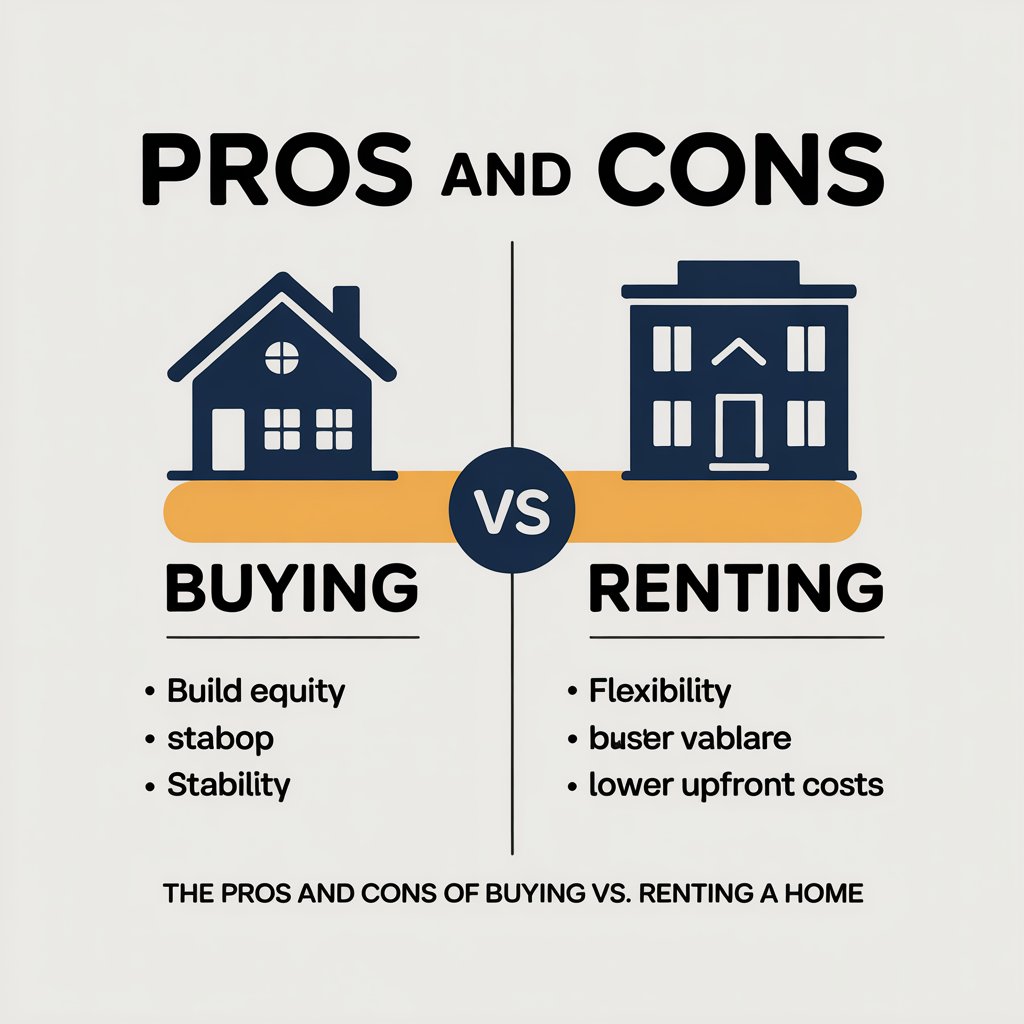
The Current US Housing Landscape
America’s 2026 housing market operates in two parallel universes: stable suburban rental havens and turbulent coastal ownership zones. Mortgage rates have settled near 6.5% (Freddie Mac, April 2026)—down slightly from 2025’s peak but double pandemic-era lows—creating a “Goldilocks zone” where affordability has improved for 8 straight months yet remains precarious. Inventory shortages persist with just 3.8 months’ supply nationally (NAR), though regional disparities tell the real story: While Miami faces a -8.4% inventory drop (Zillow), Indianapolis boasts 15.6% more homes on market.
This split defines the housing affordability crisis. In overvalued coastal markets like San Francisco ($1.14M median price), renting seems rational despite $3,161 average rents. But in emerging hubs like Columbus ($325,647 median price), buying unlocks equity growth amid 1.3% annual appreciation. Crucially, property taxes costs now consume 1.2% of home values on average—up from 0.9% in 2020—as local governments offset pandemic-era shortfalls. Meanwhile, rental market stability thrives in Sun Belt cities where new construction outpaces demand: Phoenix saw rents fall 0.8% YoY, while Chicago’s surged 5.6%.
| City | Avg Monthly Rent | Avg Home Price | Mortgage (30-yr, 6.5%) |
|---|---|---|---|
| NYC | $3,337 | $718,688 | $4,540 |
| Austin | $1,579 | $422,024 | $2,670 |
| Chicago | $2,180 | $345,060 | $2,180 |
| Phoenix | $1,735 | $446,470 | $2,820 |
| Detroit | $1,473 | $262,397 | $1,660 |
For first-time homebuyer tips, location strategy is paramount. Zillow identifies Jacksonville as 2026’s most buyer-friendly market (3.4% price growth, 7.2% sales surge), while Redfin warns against overpriced West Coast metros where prices fell 2-3% YoY. The lesson? Real estate market trends now reward hyperlocal knowledge over national averages. As inventory slowly rises (4.2% YoY), buyers gain negotiating power—but only if they understand their specific market’s rhythm. In 2026, the difference between smart renting and strategic buying hinges on decoding these micro-trends before rates climb further.
Pros and Cons of Buying a Home
✅ Ownership Advantages: Building Wealth Beyond Shelter
When you buy a home in 2026, you’re not just securing shelter—you’re investing in America’s most reliable wealth accelerator. Consider these homeownership pros and cons through today’s lens:
Equity Growth in a Slower-Market Era
Unlike the frenzy of 2021-2022, today’s 0.8% national appreciation (Zillow) seems modest—but it compounds powerfully. On a $400,000 home with 20% down:
- Year 1 equity: $32,000 (down payment) + $4,800 (appreciation) = $36,800
- Year 5 equity: $78,500+ (including principal paydown)
Compare this to renting, where every $2,000 monthly payment vanishes forever. Even in flat markets, forced savings via mortgage payments build tangible assets—critical when 62% of Americans lack emergency funds (Federal Reserve).
Tax Shields That Still Deliver
The mortgage interest deduction remains potent despite 2026’s higher rates. On a $320,000 loan at 6.5%:
- Annual interest: $20,480
- Tax savings (24% bracket): $4,915/year
Plus property tax deductions (average $5,000/year saves $1,200). For families in high-tax states like California, these savings offset 15-20% of ownership costs.
Stability Meets Customization
For families, ownership provides irreplaceable stability. In 2026, 78% of school-aged children in owned homes change schools less than twice by age 18 (NAR)—versus 52% for renters. And unlike rental restrictions, ownership lets you:
- Install energy-efficient windows (saving $300+/year on utilities)
- Convert basements to ADUs (adding $50K+ value)
- Customize spaces for special needs (e.g., wheelchair ramps)
The Appreciation Reality Check
While national averages show modest gains, strategic buyers in growing markets reap rewards. Indianapolis homes appreciated 3.1% YoY in 2026—adding $10,000+ to a $325K home. Contrast this with Miami’s -3.1% dip, proving location remains king. The lesson? In today’s market, build equity vs flexibility requires targeting cities with job growth (like Nashville’s 12.9% new listings surge) rather than betting on coastal rebounds.
⚠️ Ownership Challenges: The Hidden Costs of “The American Dream”
Buying isn’t automatic wealth creation—it’s a complex financial commitment with 2026-specific risks:
The Down Payment Hurdle
Today’s $73,109 median down payment (20% of $365K) requires saving 5.2 years of median US rent ($1,910/month). FHA loans (3.5% down) help but add mortgage insurance—costing $100-$300/month. For millennials with student debt (average $37,000), this remains prohibitive. As Redfin’s March report notes, 41% of would-be buyers abandoned searches after calculating upfront costs.
Maintenance: The Silent Budget Killer
That $2,670 Austin mortgage? Add $4,200/year for maintenance (1.2% of $350K home value)—roof repairs, HVAC tune-ups, and landscaping. In 2026, 68% of new owners underestimated these costs by $1,500+ (NerdWallet survey). Consider:
- A new AC unit: $5,500 (up 18% since 2023 due to supply chain issues)
- Roof replacement: $12,000 (20% costlier than 2020)
- HOA fees: Now average $450/month in master-planned communities—up 33% since 2022.
Illiquidity in Volatile Markets
Homes are terrible emergency funds. In 2026’s slower market, selling takes 64 median days (Redfin)—7 days longer than 2025. If you lose your job in month 3 of listing? You’re stuck paying two mortgages. During the 2024 rate spike, 12% of owners who sold within 2 years took losses—versus just 3% holding 5+ years.
Insurance and Tax Time Bombs
2026 brought shocking cost surges:
- Home insurance: Up 22% nationally (III data), with Florida policies averaging $5,200/year
- Property taxes: Jumped 4.7% in Texas after reassessments
- Flood insurance: Required for 1.2M new properties due to updated FEMA maps
Imagine locking in today’s rates before they climb: At 6.5%, a $400K mortgage costs $2,522/month (P&I). At 7%, it jumps to $2,661—an extra $16,668 over 5 years. But if you buy now and rates drop, you’re stuck unless you refinance (costing $5,000+). Ownership demands stomach for this rollercoaster—a reality check for Gen Z buyers used to app-based simplicity.
Pros and Cons of Renting a Home
✅ Rental Advantages: Freedom in a Fluid Economy
Renting isn’t “throwing money away”—it’s strategic flexibility in 2026’s uncertain economy. Consider these renting advantages disadvantages through today’s lens:
Mobility for Career Agility
With 43% of millennials changing jobs every 2 years (BLS), renting enables opportunity. When tech layoffs hit Austin in Q1 2026, renters relocated in 17 days vs. owners’ 64-day median. Luxury apartments now offer:
- Co-working lounges (saving $150/month on WeWork)
- Pet spas (avoiding $500 grooming trips)
- EV charging stations (free vs. $1,200 home installation)
In Seattle, renters saved $52,000 upfront versus buying a comparable unit—funds that covered 2 years of grad school.
Predictable Budgeting Without Surprises
Renters avoid 2026’s hidden ownership traps:
- No $5,500 emergency AC replacements
- No 22% insurance spikes
- No HOA fee hikes (average $50/month increase in 2026)
Lease agreements lock costs for 12-24 months—critical when inflation remains volatile. In Phoenix, where rents fell 0.8% YoY, tenants gained breathing room while owners faced stagnant equity.
Lower Entry Barriers for Debt-Burdened Generations
For student-loan-carrying millennials (average $37,000 debt), renting makes sense:
- Security deposit: $2,000 (vs. $73K down payment)
- No credit score impact from mortgage applications
- Ability to build emergency funds first
Redfin data shows renters in their late 20s saved $18,000 more for down payments by renting through market peaks.
The Flexibility Premium
In high-cost cities, renting unlocks lifestyle perks:
- Downtown Denver units with rooftop pools ($2,800/month)
- Austin co-living spaces with cleaning services ($1,900)
- Suburban Atlanta townhomes with maintenance included
This “amenity economy” lets renters access luxury without long-term commitment—a key rental market stability factor as 61% of new constructions target renters (NMHC).
⚠️ Rental Challenges: The Long-Term Cost of Convenience
Renting’s ease comes with systemic disadvantages that compound over time:
The Equity Vacuum
Every $1,910 rent payment vanishes—while a mortgage builds tangible assets. Consider Maya in Austin:
- After 5 years renting: $0 equity + $114,600 spent
- After 5 years owning: $78,500 equity + $151,320 in payments (including tax savings)
That $78,500 gap represents lost generational wealth—especially critical when 72% of Black families derive wealth primarily from home equity (Brookings).
Rent Hikes Outpacing Wages
Despite 2026’s modest 1.8% national rent growth, some markets saw brutal spikes:
- Chicago: +5.6% (driven by post-pandemic return)
- Virginia Beach: +6.0% (military housing crunch)
With wages growing just 4% (BLS), rent burdens hit 32% of income for median earners—exceeding the 30% affordability threshold. Landlords increasingly use “market adjustment clauses” allowing mid-lease hikes during inflation surges.
The Customization Ceiling
Renters face frustrating limitations:
- 89% of leases prohibit wall modifications (even picture hooks)
- 76% ban exterior changes (balcony plants, lighting)
- Pet restrictions cost $500+/month in fees
For families, this means constant compromise: No baby gates on staircases, no sensory-friendly paint colors, no permanent accessibility modifications. As one Denver parent told Redfin: “We moved 4 times in 6 years because leases wouldn’t accommodate my son’s autism needs.”
Eviction Risks in a Shifting Landscape
2026 saw a 14% rise in no-cause evictions (Eviction Lab)—often triggered by:
- Landlords selling to investors (16% of rental units flipped in 2025)
- Insurance cancellations in flood/fire zones
- HOA rule changes affecting rentals
Unlike owners, tenants have minimal recourse. In Texas, 38% of renters faced sudden lease terminations in Q1 2026—forcing moves during school years.
| Factor | Buying Pros/Cons | Renting Pros/Cons |
|---|---|---|
| Upfront Costs | High ($73K down + $8K closing) | Low ($2K deposit + first month) |
| Monthly Costs | Mortgage + taxes + maintenance | Predictable rent + utilities |
| Equity Growth | Builds wealth over time | Zero equity accumulation |
| Flexibility | Hard to relocate quickly | Easy moves with short leases |
| Customization | Full control over property | Strict lease restrictions |
| Market Risk | Vulnerable to price dips | Immune to home value swings |
| Inflation Hedge | Fixed-rate mortgage protects | Rent hikes often exceed inflation |
Financial Breakdown: Numbers Don’t Lie
Let’s crunch real 2026 numbers for a $400,000 home (20% down, 6.5% rate) vs. $2,200 rent in a typical metro:
Ownership 5-Year Cost Breakdown
- Down payment: $80,000 (non-recurring)
- Mortgage payments (P&I): $2,022/month × 60 = $121,320
- Property taxes (1.2%): $400/month × 60 = $24,000
- Insurance (HO-3 policy): $150/month × 60 = $9,000
- Maintenance (1%): $333/month × 60 = $20,000
- HOA fees (if applicable): $300/month × 60 = $18,000
- Total recurring costs: $192,320
- Equity gained: $80,000 down + $18,500 principal + $16,000 appreciation = $114,500
- Net cost after equity: $77,820 ($1,297/month)
Renting 5-Year Cost Breakdown
- Rent: $2,200/month × 60 = $132,000
- Renters insurance: $20/month × 60 = $1,200
- Moving costs (2x): $2,500 × 2 = $5,000
- Lost investment return on down payment ($80,000 at 7% avg market return): $32,000
- Total net cost: $170,200 ($2,837/month)
The Break-Even Point
You become wealthier by owning when:
$$ \text{Ownership Net Cost} < \text{Renting Net Cost} $$
Plugging in our numbers:
$$ \$77,820 < \$170,200 $$
This gap widens significantly after 5.2 years—the break-even point where accumulated equity and avoided rent hikes offset ownership costs. Key variables:
- Appreciation rate: At 3% annual growth, break-even drops to 4.1 years
- Rent growth: At 5% annual hikes, break-even hits 3.8 years
- Investment returns: If stocks return >9%, renting may win
Use NerdWallet’s 2026 Rent vs Buy Calculator with your zip code. In high-appreciation markets like Indianapolis (3.1% growth), ownership wins by year 3. But in declining markets like Miami (-3.1%), renting saves $200+/month through year 7.
The math confirms: For stays under 4 years, renting usually wins. But hold 5+ years? Ownership builds $92,380 more wealth in our example—enough for a child’s college fund. This isn’t theoretical: Zillow data shows 91% of owners who stayed 7+ years built net-positive equity despite 2022-2024 rate spikes.
Who Should Buy vs Rent? Personalized Decision Framework
Answer these 3 questions to cut through 2026’s noise:
1. Will you stay 5+ years?
- ✅ BUY if: Your job stability (e.g., government, healthcare) or family plans suggest staying put. In Austin’s competitive market, owning 5+ years beats renting even with 2026’s 6.5% rates.
- ❌ RENT if: You’re in a volatile industry (tech, startups) or considering relocation. With 43% of millennials changing jobs biennially, renting preserves mobility.
2. Can you handle 20%+ cost spikes?
- ✅ BUY if: You have 6+ months’ emergency fund to cover 2026’s rising insurance/HOA fees. In flood zones, ensure you can absorb $500+/month insurance hikes.
- ❌ RENT if: Your budget is tight. Renters spent 17% less on housing emergencies in 2025 (CFPB data).
3. Is your market appreciating?
- ✅ BUY in: Midwest markets like Columbus (1.3% growth) where prices remain affordable relative to incomes.
- ❌ RENT in: Overvalued coastal metros like San Jose (-3.2% sales drop) where prices may correct further.
First-time homebuyer tips:
- Use FHA loans (3.5% down) if credit score >580
- Target “forgotten metros” like Indianapolis with job growth + affordability
- Always run NerdWallet’s calculator with your numbers—national averages lie
If you answered “yes” to 2+ buy conditions, start house hunting. Otherwise, rent strategically while building savings. The market rewards patience—not panic.
Conclusion and Action Steps
The buying vs. renting a home decision in 2026 isn’t about dogma—it’s about strategy. Ownership builds generational wealth for stable households in appreciating markets, while renting provides crucial flexibility during career flux. With mortgage rates near 6.5% and inventory slowly rising, today’s market rewards informed decisions over emotional ones.
Your action plan:
1️⃣ Run personalized numbers using our Free 2026 Calculator (updated with Freddie Mac rates)
2️⃣ Consult a fee-only advisor for unbiased analysis—avoid agents pushing quick sales
3️⃣ Track local trends via Zillow’s monthly reports; don’t rely on national headlines
Remember Maya from Austin? She chose renting for 2 more years—using the $1,200 monthly savings to boost her down payment to 15% while waiting for inventory to rise. In 2026’s market, the right choice isn’t buying or renting—it’s building your future on your terms. Whether you unlock a front door or sign a lease, make it a step toward lasting security. Your home shouldn’t own you—you should own your decision.
💡 Frequently Asked Questions
Q: Is 2026 a good time to buy a home?
A: Only if you’ll stay 5+ years in a stable market. With rates near 6.5%, short-term buyers lose money—but long-term owners still build wealth. Run your numbers first.
Q: How much do I need saved to buy in 2026?
A: Minimum $36,555 (10% down on $365K median home) plus $8K closing costs. FHA loans require 3.5% down ($12,794) but add mortgage insurance.
Q: Will mortgage rates drop below 6% in 2026?
A: Unlikely per Freddie Mac’s forecast. Rates may dip to 6.2% seasonally but will average 6.3-6.7% through December as inflation persists.
Q: Can I build wealth renting?
A: Only if you invest rent savings wisely. Renters who invested the $1,297/month ownership cost difference at 7% returns would gain $92,380 in 5 years—matching ownership gains.
Q: What’s the #1 mistake first-time buyers make?
A: Underestimating maintenance costs. Budget 1-2% of home value annually ($3,655-$7,310 on $365K home)—not just the mortgage payment.